Blog Post
S2:E28 2021 State of Maintenance Report Recap with Rob Kalwarowsky and Ricky Smith
In this episode of MIM, we are excited to have Ricky Smith and Rob Kalwarowsky on the show to talk about the 2021 SoM Report!


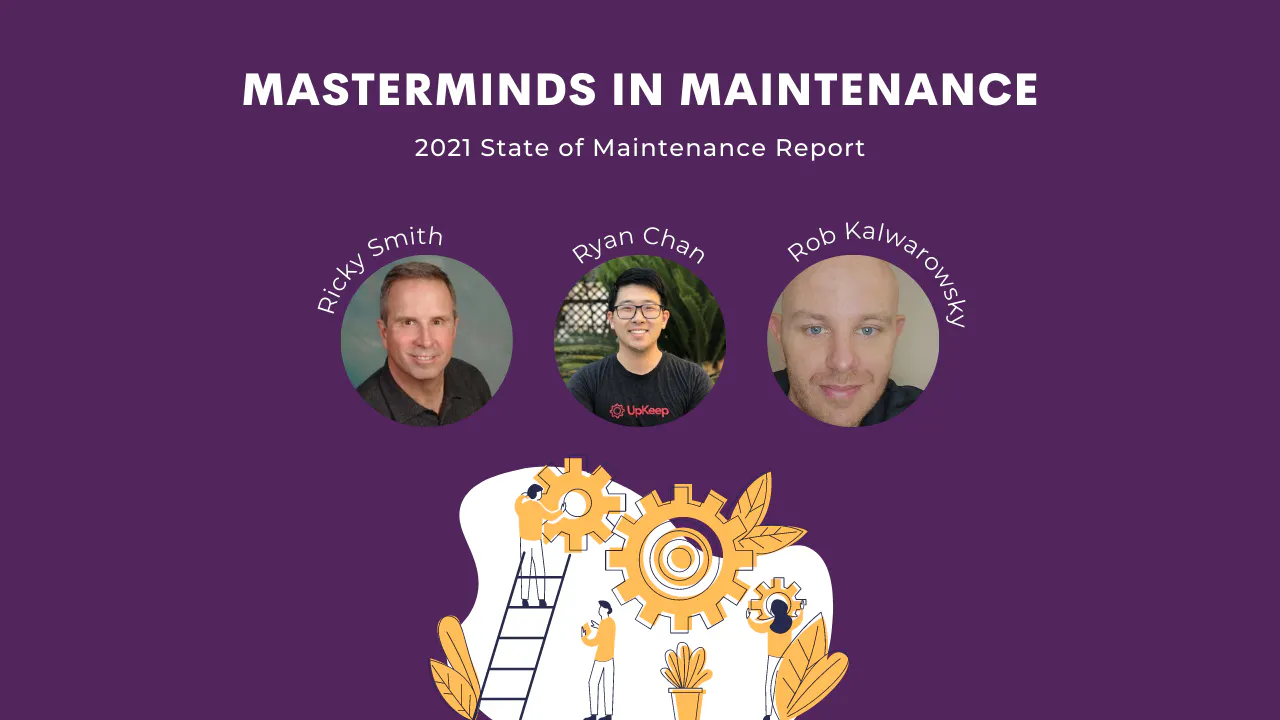
Ricky Smith is the Expert in Residence at UpKeep, where he teaches our internal team and wider community more about maintenance and reliability! And, we also have Rob Kalwarwosky who is an Asset Management Specialist at Enbridge and the creator of Rob’s Reliability Project (now rebranded to Maintenance Disrupted)!
Summary
In this week's episode of Masterminds in Maintenance, we are excited to have two familiar faces back on the show, Rob Kalwarowsky and Ricky Smith! Ryan, Rob, and Ricky were on a panel together recently to discuss the 2021 State of Maintenance Report.
Check out the 2021 State of Maintenance Report here!
The report features the voices of over 1,000 maintenance and reliability professionals, as well as 25 industry thought leaders. This report revealed some awesome insights about team goals, shared challenges, opportunities for innovation, and so much more.
For this episode, Ryan, Rob, and Ricky do a bit of recap and debrief on the report, and share their own personal thoughts and reflections on the report’s findings! Listen today!
[Embedded content: https://anchor.fm/upkeep/embed/episodes/S2E28-2021-State-of-Maintenance-Report-Recap-with-Rob-Kalwarowsky-and-Ricky-Smith-er1o67]
Episode Show Notes
Podcast Platforms
Transcript
0:00:05.1 Ryan: Welcome to Masterminds In Maintenance, a podcast for those with new ideas in maintenance. I'm your host, Ryan. I'm the CEO and Founder of UpKeep. Each week, I'll be meeting with a guest who's had an idea for how to shake things up in the maintenance, reliability industry. Sometimes, the idea failed; sometimes, it made their business more successful. And other times, their idea revolutionized an entire industry. Today, I'm super excited to have Ricky Smith and Rob Kalwarowsky back here on the show. Ricky is an expert in maintenance here at UpKeep, and he teaches internal teams and the wider community more about maintenance reliability best practices. We've also got Rob here, who's an Asset Management Specialist at Enbridge. Rob's also the creator of Rob's Reliability Project, which is now rebranded to Maintenance Disrupted. Welcome, guys, to the show. Really excited to have you back on again.
0:00:47.9 Rob Kalwarowsky: It's always great to join you, thanks for having me.
0:00:49.0 Ricky Smith: I look forward to it.
0:00:51.2 Ryan: So maybe we could start with you, Rob. How'd you get started? [chuckle]
0:00:54.4 RK: I've been working in reliability for about 10 years now. I started off my career in mining, then I moved into consulting and then now, I'm in oil and gas. We're doing this to change and educate our industry, and there's a lot of learning that needs to happen. Just even just looking at the data in this report that we're gonna get into, we can see that there's a lot of learning that needs to happen.
0:01:17.0 RS: My dad was a mechanic at Exxon, so worked on about everything. Every car I ever had, I've rebuilt the engine, get it running faster, we're always something then I went in the Army, went into maintenance. When I got out of the Army, I went to work at Exxon with my dad in maintenance, and that started everything. But what really jump-started my career when I went to work for Alcoa Mt. Holly. It was Alumax Mt. Holly at the time, which was the world-class maintenance standard. I learned a lot there. And then that really took me and just thrust me into the limelight about understanding maintenance and reliability.
0:01:48.6 Ryan: You've obviously written books about maintenance, reliability. I learned so much from both you and from Rob, so thank you for being a huge part of this community, and trying to help educate and share knowledge. Ricky and Rob and myself, we were all on a panel together recently to discuss the 2021 State of Maintenance Report that we conducted. We actually talked to over 1000 maintenance and reliability professionals, as well as 25 industry thought leaders. This report really revealed to us different insights about team goals, shared challenges, opportunities for innovation, and so much more. So for today's episode of Masterminds In Maintenance, we wanted to do a little bit of a recap and a debrief on this report, and share our own personal thoughts and reflections on the report's findings.
0:02:37.0 Ryan: The first one is around PM completions and how it was a measurable KPI that doesn't necessarily equate to effective maintenance. The number one metric that was tracked with PM completions, but then what we talked about, was kind of, "Is that a good metric for effective maintenance and reliability practices?" Paul actually shared his thoughts after reading the report. When teams are pushed for higher completions with a general aim of downtime reduction, it actually creates a culture of quantity over quality as a time factor. Wanted to start here, and get you guys' thoughts on whether measuring certain maintenance metrics are actually detrimental to the quality of maintenance and reliability. And then secondly, how do teams typically reconcile this challenge?
0:03:23.5 RS: To me, it starts out with what Dr. Deming said, "If you can't measure it, you can't improve it." If you measure the wrong thing, then you're gonna have the wrong actions out of it, like PM completion or PM compliance. Okay, that could mean a lot of things to a lot of people. It just said to get it done. It doesn't say if we did it effective. That's why I like PM labor hours purchases, emergency urgent labor hours. When you put a correlation together with those two, it tells us a lot.
0:03:48.4 Ryan: We asked 1000 people: What's the KPI that you track? And PM completion was number one on the list.
0:03:56.4 RS: Yeah.
0:03:56.6 Ryan: So that's why we're talking about this because that seems like the most common metric, but obviously, I think all of us have opinions about whether or not that's the right metric to track.
0:04:07.3 RK: Get the SMRP book of metrics. It has everything you'll want to measure and more, and it'll give you formulas and best practices and all that stuff. What I wanna challenge people to think is: What are they using the metric for? And you see this a lot in safety. We're going for a million man hours without an LTI. And then what you see is you see non-reportings of LTIs, where you see people coming in on light duty to hit that metric. I was at a site that had a guy with a broken leg, and he came in and sat at a computer, instead of staying home. They hit their million man hours. But what behavior are you driving with the metric? How are you using the metric? Because if you're using it to bonus people, if you're using it to discipline people, this is where you're going to drive behaviors that you probably don't want. I can hit 100% PM compliance. I'll just go out and fill out UpKeep and say, "Complete, complete, complete, complete." I don't just mean I did anything. And I think that's the key piece for me, it's the leadership aspect around it. How are you using the metrics? Because if you're using it to learn, you're using it to understand, and you're using it to improve, that's how you should be using metrics.
0:05:20.0 RS: What would you say the objective of preventive maintenance should be?
0:05:24.4 RK: If we're talking about what, technically, PMs are for, is to reduce unplanned failures.
0:05:31.1 RS: Exactly.
0:05:32.1 RK: It's to improve our availability or reliability. Now, whether they're effective, that's a different measurement, [chuckle] that's not completion. That's: Are we finding defects? Are we reducing our reactive maintenance? All these other things that, obviously, you know, Ricky, but that is not in PM compliance.
0:05:49.4 Ryan: Why do you think that is the most common metric that companies track? Is it because it's easy, it's convenient? Is it because that's the stepping stone towards a more mature maintenance reliability department?
0:06:03.6 RK: Yeah, for me, it's easy. And I think it's easy if you don't do any PMs, and you're moving from just purely reactive maintenance. It actually is a good metric to track then because then, you're moving from one to the other. Now, if you're trying to go to this world-class maintenance program, it's not the one. Even, in addition to that, there's more things to track than just completion. If you're moving from purely reactive, you should be tracking stuff like downtime, you should be tracking stuff like what defects are you finding, percent rework, all these other metrics that sort of get at the quality aspect of the maintenance that you're doing.
0:06:42.8 RS: Yeah, metrics is your dashboard like on your car, not just a speedometer, but you also get the temperature gauge or temperature light, you got all kinds of things on there to tell you if you've got a problem. And the problem with KPIs, a lot of times, we get the wrong KPIs, so those lights never come on to tell us we got a problem.
0:06:58.8 Ryan: PM completion might not be a terrible metric to track. It depends what stage, what maturity level your company, your department is at, and also, make sure that that's not the single one and only thing that you're tracking.
0:07:12.4 RS: Right.
0:07:13.0 RK: That's right. And no metric is inherently good or bad. They are just a number. It's how you use it, that's a huge thing, and then what are you using it for. Those are the other pieces around that.
0:07:27.0 Ryan: We actually surveyed these 1000 people around this digital transformation for work, and what COVID has done, whether it's accelerated, whether it's pushed for more digital transformation within their departments. And what we actually found was 66%, so 2/3s of our respondents actually said that they are now using a CMMS, a digital work order management solution, which is up from last year, to track maintenance, reliability, work orders, parts inventory, and all their assets. What are some trends that you guys think will happen with this digital transformation for work in maintenance and reliability, more specifically here?
0:08:07.2 RS: The problem is a lot of times, when we're using a CMMS, we're not using it the right way. What year is this? [chuckle] Come on! And we're not using a CMMS. In 1980, the company I worked for had a first fully-integrated maintenance software in the world. The CMMS, it ain't the problem. The problem is people are not either implementing it correctly or not utilizing it, which is the most probably the highest percent, they're not using it correctly.
0:08:31.6 Ryan: Yeah.
0:08:31.8 RK: And of course, technology is gonna increase. This is the nature of the world. And even COVID pushed a change on a lot of companies. You couldn't do some of the practices. I don't go to work anymore. I stay home and work. So if I can't access the CMMS, then I can't be as effective as I could be. We all have cellphones now, and we didn't 30 years ago. So I don't think it's that surprising to me. I think more adoption in terms of IIoT solutions as well. And again, it's what Ricky said is completely right. It's not; The solutions themselves work; it's more the people aspect around it. And I think that's the piece, it's usually lacking in our industry, and it's change management and leadership around the implementation of all these things. And it doesn't just talk about technology, RCM, RCA, all those predictive maintenance programs, it's all the same stuff. It boils down to: How are you doing change management? What's your leadership looking like? And how are you actually closing the loop? Our results aren't incredible. We have all this knowledge and yet, we're not getting incredible results.
0:09:42.4 Ryan: In any change, there's... Or let's call it digital transformation as we talk about that. There's two main components. There's people, and then there's technology. Where do you think the bottleneck is right now as it stands in 2021? Do you think that it's more of a people problem? Or is it a technology advancement that we need to make?
0:10:02.7 RK: I think it's a people problem. I think it's probably 95 to five or something. [chuckle]
0:10:06.9 RS: Yeah, I agree.
0:10:07.5 RK: UpKeep software works; there's no debate that it doesn't work. And yet, there are customers that you have that are not effectively executing maintenance.
0:10:16.0 RS: You hear that all the time. I mean, "Our maintenance software doesn't work." "But why doesn't it work?" "It just doesn't work." You can blame it on a lot of things, but it comes down to the human. Implement it correctly, which is not typically a problem. Typically, the problem is people are not using it.
0:10:32.6 Ryan: Maybe the flipside to that, and just to challenge this a little bit, is that people don't use technology because... And what we found in the market is that technology for this industry is, oftentimes, very bad. It's difficult to use. We think that there's a big disconnect between what a lot of technology providers build, versus what's actually usable. Maybe it's a little bit evened out, maybe 80-20, Rob? What do you think? [chuckle]
0:11:00.1 RK: Yeah, there's no doubt. I've used a bunch of bad reliability softwares and stuff, but people talk to me now about the IoT and these AI solutions that they detect vibration failures and stuff. They wonder why they don't get results from those. It comes down to the people aspects. If I can detect a failure six months in advance, it doesn't change anything if I don't actually take an action and order the replacement, or go out and fix it, or do any of these things. People are using that to just watch their equipment fail, [chuckle] and then worry about it when it breaks. And I think that's the issue, and it comes back to how are you showing up at your site, what are you actually building in terms of proactivity and it's people in leadership, for me.
0:11:47.8 RS: The problem is we use PDM. So identify a large horsepower motor, it's a critical asset, critical component, and it's gonna fail 'cause we got a bearing fault. Okay. The bearing fault is not gonna go away; it's gonna get worse, and it's gonna fail randomly. What we should do, and what most companies don't do, is just go ahead and plan the job. We may not schedule it now, but we need to go ahead and plan it. Just in case it does fail, we've got the part, we've got the material, we got the procedure, we got everything ready. All we gotta do is say, "Okay, the motor is down. We didn't make it to the thousand today." So we just pull it out and we replace it. We do it right, we're not in a hurry.
0:12:21.3 RK: Yeah.
0:12:21.9 RS: 'Cause I know when someone says, "How long is it gonna take?" We've already scoped the job, it's gonna take four hours. "Four hours? My gosh, last time you did it in two." "That's right, that's why we're back to the same problem again. The same asset.
0:12:33.1 Ryan: So we've been conducting the state of maintenance report every single year for the past couple of years. And now obviously, we're gonna do it again next year, what do you hope would change the next time around, what are your guys' predictions as we look forward one year from now, and we look back at the State of Maintenance Report 2022?
0:12:55.0 RK: Yeah, I think it's gonna be very much the same. What I would like to see though, in a dialogue in our industry, is to go away from this aspect of trying to solve all our problems by throwing technology or processes or procedures at things. What I would like to see is more leaning into people, and I know Ryan, you and I have talked about this a lot, but I think that's the real game-changing thing. And Shadrach talks about it in terms of collaboration. That's absolutely an opportunity for us. There's absolutely opportunities in terms of diversity and inclusion, and I think there's also absolutely opportunity in terms of treating our people like people, getting them trained, getting them confident in them showing up and doing jobs, trying to make a better workplace. I think that a lot of us work in these places where we're kinda checked out and we're getting hammered all the time, and that's why we're not getting anywhere.
0:13:50.9 RS: I guess the biggest thing for me is that to get people to move in the right direction, 'cause one, we gotta give them a vision in what the right direction looks like, it's called a whiff, and what's in it for them, what's in it for you? By moving in the right direction, is life gets better, you get to go home when you're supposed to go home, you don't have to chase failures all day long, go home dead at night, 'cause you're retired like I used to do. When you're at maintenance, it's difficult, bringing calm to the storm is what we're talking about, and that's where we're headed to, with proactive maintenance is get to the point where we know what we're doing, we know the health of the assets, we know what our problems are, and we're working on those problems to resolve them, but I want everybody pulled into it from the technician, up to, at least a maintenance management level, I don't know if I wanna get any higher than that, because sometimes that gets a little crazy.
[chuckle]
0:14:37.8 RS: But pulling people in on the team works out well.
0:14:40.6 Ryan: It's really cool to talk about this because we've got a year, right, a year of change. And obviously we kind of know that 2020 for all of us was a year of change, so hopefully we will see a ton of really good progress moving in the right direction. What I hear from both of you guys, from Ricky and Rob, is the focus on people. The focus on the human aspect of people coming in to work, turning wrenches, I kind of reflect back how we started the conversation around KPIs, and it's kind of like the complete polar opposite of that actually, it's not just hitting, going into UpKeep or CMMS and just hitting, done, done, done, done, done, these are people, we're all human beings, and we all have the creativity, the mindset to wanna do bigger and better things than just done, done, done, done, done, but if that's how we're measured, if that's what success looks like, that's exactly what you're gonna get. [chuckle] To kinda wrap things up, we all know that maintenance reliability teams through the last year or so has been extremely resilient through COVID-19 in so many different aspects, financially, emotionally, mentally.
0:15:47.7 Ryan: And I wanted to end here to basically encourage all our listeners who are out there on the front lines, keeping our world safe during this challenging time, any words of encouragement, hope that you guys would like to share, Ricky and Rob?
0:16:00.6 RS: Gaining knowledge will help you succeed. The biggest thing I've been focused on is that training, Rob, you gotta get education on best practices, you got to understand and feel it and then go out and apply it, and going to training just to get a certificate is a waste of time. You need to go to training to bring something back, to take that next level of step for yourself, which ultimately result in your organization doing better too.
0:16:23.4 RK: I love that, and I see it so much, and that's where some of the stuff that the training that I've been rolling out at least in the leadership side has included a mindset piece, it changes it from knowledge to, this is how, who I am, this is what I do every day, and I think that's huge. And the only other thing I wanna add to that, Ryan, this is the time to lean into empathy, and I see so often, and I've seen a lot this year with budget cuts and all these things is people are starting to get into this war between us and management or maintenance and operations, and it's very much like, they're wrong and we're right.
0:17:00.5 RS: Yeah.
0:17:00.9 RK: And I think the key here as leaders is, is empathy, it's like what's their point of view? If they didn't cut the budget, how would have they gotten hammered by the board or the stock market or whatever, right? Their manager or their external thing. And that's what I wanna leave people with is just, we're all people, we're all trying to do the best that we can, and if we just fight each other, it's not getting us anywhere.
0:17:26.4 Ryan: Thank you so much, Ricky and Rob, how can our listeners follow you guys on your journey and connect with you?
0:17:31.9 RK: So I got two podcasts right now, you can see them both up here, so I have Dismantling The High Performance Narrative, it's a podcast about mental health and performance. You can hear me and Lauren and a few other guests talk about our experiences with mental health challenges and just how we're going forward in terms of performance and vulnerability. The other podcast up here, The Leadership Launchpad Project, that's where we're gonna talk all things leadership. We're gonna talk about human-centric leadership and these terms like empathy and vulnerability and courage, that's where we're going on that show. You can find both of those on your favorite podcast platform, and if you wanna find out anything about the services that I offer, the leadership coaching or the reliability group, you can go to robsreliability.com and find it there, and if you wanna hire me as a consultant, you can go to UpKeep Connect as well, and I know Ricky's on that, so Ricky, that's all from me. [chuckle]
0:18:25.0 RS: Yeah. That's right, both of us.
0:18:26.8 Ryan: And I know both of you guys are very active on LinkedIn, so if you wanna follow Ricky Smith or Rob Kalwarowsky, and you can find them on LinkedIn.
0:18:34.3 RS: My website, worldclassmaintenance.org. So worldclassmaintenance.org. There's a lot of free information on there, it doesn't require an email address to download whatever you want, there's a lot of articles I've written. Most of my articles I've written were out of frustration of what I see, that people don't have the knowledge or they don't see the vision for it, so go on there, download whatever you want, just leave the rest. Okay?
0:18:56.4 Ryan: Well, thank you guys so much, I really appreciate you joining us, and thank you to all of our listeners for tuning into today's Masterminds In Maintenance. My name is Ryan, I'm the CEO and Founder of UpKeep. You can also connect with me on LinkedIn or shoot me an email directly at [email protected]. Lastly, you can find me, Rob and Ricky in the maintenance community on Slack, it's the largest online community for maintenance professionals in the world, where we host weekly conversations contests, all centered around maintenance and reliability. I hope to connect with all you guys soon, until next time.
0:19:27.7 RS: Thank you guys.
Be a part of the world's first Slack Group solely dedicated to those in the maintenance and reliability industry!
Connect and network with over 3,000+ professionals working across 20+ different time zones, attend and receive recordings of free webinars and workshops, ask questions and engage in live discussions with industry experts, and so much more!
Sign up now and meet with maintenance and reliability professionals today!
Join the Masterminds in Maintenance Podcast!
Want to keep reading?



Article
How To Build an Efficient Preventive Maintenance Checklist


Article
How to Implement a Preventive Maintenance Program


Article
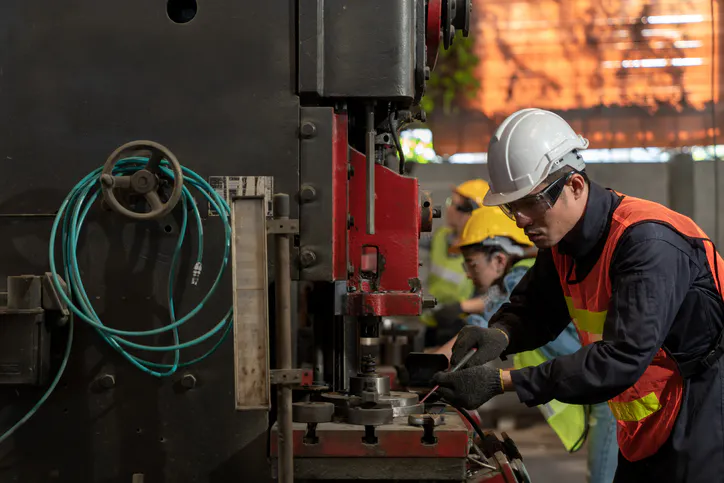
Why Is Preventive Maintenance Cost Effective?
4,000+ COMPANIES RELY ON ASSET OPERATIONS MANAGEMENT
Leading the Way to a Better Future for Maintenance and Reliability
Your asset and equipment data doesn't belong in a silo. UpKeep makes it simple to see where everything stands, all in one place. That means less guesswork and more time to focus on what matters.




![[Review Badge] Gartner Peer Insights (Dark)](https://www.datocms-assets.com/38028/1673900494-gartner-logo-dark.png?auto=compress&fm=webp&w=336)