Blog Post
Improve Workforce Efficiency and Productivity With UpKeep
Data collection is an issue close to our hearts at UpKeep. Our Asset Operations Management approach is based on the easy capture of active and passive data.


Maintenance, reliability, and operations teams face a number of challenges every day; many of which include workforce productivity and efficiency. Improving operational efficiency at any company is no easy task, though. It relies on making dispersed, deskless teams more effective at not only carrying out their day-to-day activities, but also improving the quality and quantity of data these teams generate—data that ultimately impacts both asset and business performance.
Unfortunately, a large number of supposed connected worker and CMMS solutions focus solely on optimizing basic aspects of a frontline worker’s job—like making it easy to log a work order—and then stopping there. These solutions must go beyond simple work order management and deliver on two key requirements:
Making it easier to capture high-quality data from the field
Increasing insight across teams, i.e., connecting the field with the office and boardroom
From the very beginning, UpKeep has been the leader in developing mobile-first, connected worker solutions that prioritize ease-of-use and value for frontline maintenance, reliability, and operations workers. Our approach to connected, digital workers is oriented toward encouraging adoption and frequent use through holistic, easy asset data capture.
Why Modern Workers Need a Mobile-First Solution
Ease of data capture, and the ability to connect daily work to executive metrics, are no longer nice-to-haves. These are essential for the worker and organization for a number of reasons.
For one, a new generation of digital-native professionals is now entering the workforce. These individuals expect that the technology they use at work will be as easy to use as the consumer-grade technology they use every day. However, that’s usually not the case. It’s estimated that only 25% of a frontline technician’s day is spent on productive work, and a big part of that is due to clunky, outdated software.
Furthermore, organizations and their end users are consistently expressing a need for mobile applications that do more than submit work order tickets. These workers have new requirements focused on areas like user experience. According to IDC, “Managers and technicians rely on mobile-first applications to not only collect data in the field, but also to empower workers with insights and automated workflows to improve outcomes.”
In addition to the above, it’s clear the importance of mobile is growing as a direct result of organizations’ intent to get better at data capture to fuel meaningful insights. In fact, IDC predicts that in this year alone, 75% of organizations will use mobile solutions to improve unstructured data collection at the point of activity.
How UpKeep Makes Technicians More Efficient and Productive
Data collection is an issue absolutely close to our hearts at UpKeep. Our Asset Operations Management approach is based on the easy capture of active and passive data. This issue is particularly important for technicians because too many connected worker solutions claim ease of use but few demonstrate it in meaningful ways.
While it may be easy to create and log a work order, work itself—and consequently, workforce productivity—is not easy.
That’s why our mobile approach prioritizes not just ease-of-use in terms of reducing friction, but also in terms of adoption and engagement. We strive to provide a streamlined, easy-to-use mobile experience that helps technician’s get their job done faster. Here’s how.
Less Distractions
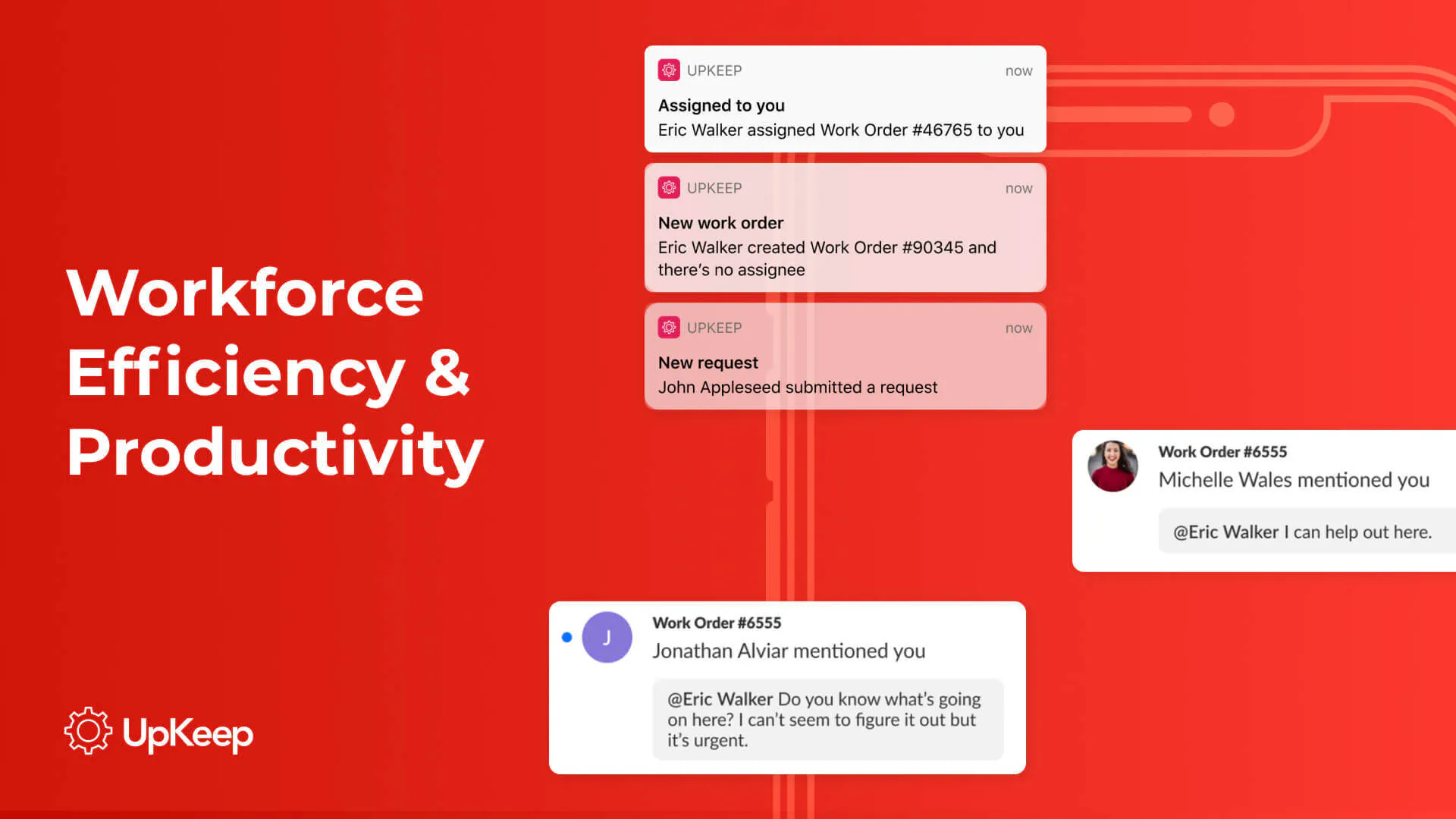
Notifications can be a blessing and a curse. The line that separates the two outcomes is intentionality. Notifications should help, not hinder, which is to say they should communicate important information. Nowhere is this more important than for field teams—already stretched thin and juggling multiple work streams across assets, locations, or both.
UpKeep’s perspective has been to make notifications more useful by reducing information overload. This is achieved through eliminating any excessive communication related to a work order, and by ensuring technicians only get the notifications they need—not every bit of communication.
Less Complexity
One of the disadvantages of digital communication and collaboration is the vast amount of information directed at the people who actually use the technology. Much of this information is distributed across different areas in an application or even across applications. The result? Excessive searching for technicians, along with a seemingly endless communication stream divorced from work orders, assets, and more.
All of this is enough to force technicians to turn off notifications and/or discard their mobile tools, which seriously impacts data capture, collaboration, and communication—simple issues that tangibly impact the ROI organizations hope to get from their technology solutions.
To remedy this issue, UpKeep built a consolidated notifications hub that centralizes all notifications for a technician. But more importantly, technicians are able to seamlessly navigate from the hub into their work through the relevant notification, saving precious time otherwise wasted on searching for certain work orders.
More Visibility
No one wants to run an endless marathon, and technicians are no different. Creating buy-in for a software solution is never easy, but it’s that much harder if you give technicians complex software that increases friction and prevents them from getting better at their job.
That’s why we’ve built analytics for technicians to help them see their quantifiable impact on operational efficiency. The My Impact feature on UpKeep’s mobile application gives technicians a direct line of sight into the work they’ve done, including completed work orders, on-time completions, and so much more.
UpKeep Is the Leader in Mobile-First Solutions
Taken as a whole, these features represent more than just an intentional approach to making user-friendly software. These features represent a living demonstration of Asset Operations Management, in that they encourage technician adoption not only by reducing friction, but by also connecting their work to the business as a whole through both their own impact and efficient data capture.
Want to keep reading?

Article
Optimize Asset Management With UpKeep’s EAM Solution


Article
Mobile Equipment Inspection Optimization



Article
Asset Operations Management | Four Key Ingredients
4,000+ COMPANIES RELY ON ASSET OPERATIONS MANAGEMENT
Leading the Way to a Better Future for Maintenance and Reliability
Your asset and equipment data doesn't belong in a silo. UpKeep makes it simple to see where everything stands, all in one place. That means less guesswork and more time to focus on what matters.






![[Review Badge] Gartner Peer Insights (Dark)](https://www.datocms-assets.com/38028/1673900494-gartner-logo-dark.png?auto=compress&fm=webp&w=336)