Blog Post
Fleet Maintenance Parts Inventory Software: What It Does and What to Look For
Learn how fleet maintenance parts inventory software automates reordering, tracks costs per vehicle, and eliminates repair delays to keep technicians working.



Key Takeaways
Automated reorder triggers prevent stockouts without the need for manual oversight. Parts arrive before technicians need them, not after an empty shelf forces a repair to stop mid-job.
Work order integration confirms parts availability before a repair is scheduled, eliminating the mid-repair discovery that extends turnaround time and idles technicians.
Consumption tracking by vehicle uncovers which assets burn through parts fastest and is an early indicator of underlying mechanical issues that scheduled PM hasn’t yet caught.
Warranty tracking recovers costs most fleets miss. Parts replaced without checking coverage represent direct recoverable costs that disappear into manual processes.
Per-asset cost reporting exposes which vehicles are draining MRO budgets disproportionately, and that data informs defensible repair-versus-replace decisions.
Every hour a technician sits idle is lost wrench time, a delayed repair, and a vehicle that stays out of service longer than necessary. It’s a parts management failure, not a mechanical one.
Fleet managers track vehicle downtime. Delays due to missing parts are included in that number, so the inventory gap driving the delay doesn’t surface as a problem in its own right. Instead, it shows up as a maintenance cost rather than a procurement failure and isn’t fixed.
Fleet maintenance parts inventory software closes that gap by connecting stock levels, reorder triggers, and consumption data directly to the work order process. The result is repairs that start when they’re scheduled, not when a missing part finally arrives.
What Is Fleet Maintenance Parts Inventory Software?
Fleet maintenance parts inventory software tracks stock levels, consumption patterns, and reorder triggers for a vehicle fleet. It connects to work orders so technicians can confirm availability before starting a job.
A general inventory system tells you how many brake pads are on the shelf. A fleet-specific system tells you which vehicles are consuming brake pads faster than the PM interval expects, which work orders are waiting on parts right now, and which assets are driving the highest parts spend per mile.
For active fleet operations, parts inventory is one module within a broader CMMS rather than a standalone tool.
The Real Cost of Unmanaged Parts Inventory


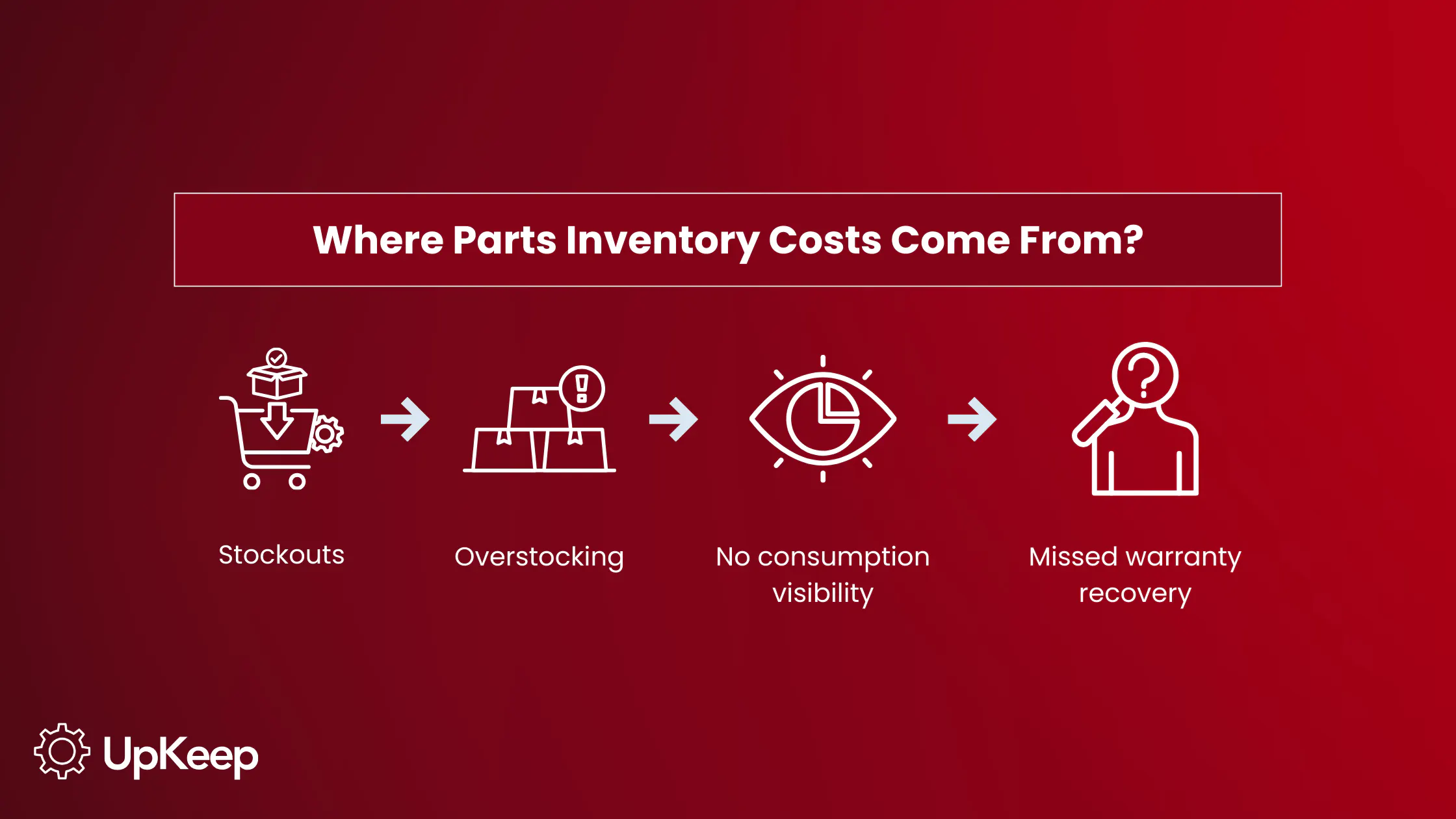
Unmanaged inventory creates four distinct cost drivers, and active fleet operations typically absorb all of them simultaneously.
Stockouts
A repair that should take two hours becomes a two-day delay when a common item isn’t stocked. The technician is idle, the work order stays open, and the vehicle stays out of service while a part is sourced, translating to direct labor waste, extended downtime, and a backlog that compounds.
Reactive and emergency maintenance is widely estimated to cost two to five times more than planned work once overtime labor, expedited parts, and downtime impacts are included. The exact multiplier varies by operation and which cost categories you count.
Overstocking
Inventory that sits on a shelf carries an annual cost. A common rule of thumb puts annual inventory carrying cost around 15%–25% of inventory value, though it varies significantly by industry and what’s included in the calculation.
For a fleet carrying $250,000 of on-hand parts, that’s $37,500–$62,500 per year before a single part is installed. Fleets that order based on memory or gut feel tend to face two problems at once: stockouts of high-use consumables and dead inventory of parts that never turn.
No Consumption Visibility
Purchasing decisions without consumption data default to guesswork. High-use vehicles end up under-stocked, while low-use vehicles accumulate inventory that never moves.
The budget impact compounds in both directions: Parts spend that isn’t tracked by asset hides, which vehicles are draining the MRO budget, and without that data, there’s no defensible basis for a replacement decision.
Missed Warranty Claims
Parts replaced without checking warranty status represent recoverable costs that manual processes don’t recover. There’s no system linking the replacement to warranty records at the point of purchase, so the loss goes unrecorded. It’s small per incident, which is why it persists across a fleet for years.
Metrics to track: maintenance turnaround time, parts cost as a percentage of the total maintenance budget, and work orders delayed due to missing parts.
Critical Core Features of Fleet Maintenance Parts Inventory Software
Real-Time Stock Visibility
When a work order is created, the system checks whether required parts are on hand and reserves them immediately. Two technicians thus can’t pull from the same stock simultaneously and discover a shortage mid-job. Stock levels are accurate at the point of assignment, not when someone physically checks a shelf.
Automated Reorder Triggers
Minimum-quantity thresholds automatically generate purchase orders. Replenishment runs without the need for manual oversight because alerts trigger based on actual consumption rather than static calendar cycles. A delivery van running 200 miles a day, for instance, consumes filters faster than the calendar accounts for, so the system adjusts.
Consumption Tracking by Vehicle and Asset
Tracking which vehicles burn through specific parts at higher rates enables accurate stocking by vehicle class and uncovers early indicators of underlying mechanical issues. If brake pads are consistently replaced before the scheduled interval on a specific vehicle, that’s a sign the PM trigger needs tightening and the vehicle warrants closer inspection. Scheduled preventive maintenance sets the baseline; consumption data reveals when the baseline no longer fits.
Warranty Management
The system tracks warranty coverage by part and vendor and flags when a replacement qualifies for a claim before a purchase order is sent. Each missed claim is a small recoverable cost, but across a fleet over 12 months, the aggregate isn’t.
Multi-Location Support
Centralized visibility into stock across multiple yards or shops means a technician at one location isn’t waiting on a part sitting unused at another. Inter-location transfers are faster than supplier orders; the constraint is knowing where the inventory is.
Cost Reporting
Reports on parts cost per vehicle, asset class, and time period expose budget-draining assets before the replacement decision becomes urgent, and the data has to be assembled manually for a budget review. Generic totals such as total parts spend per month mask the per-vehicle specifics that should drive decisions.
How Parts Inventory Connects to the Broader Maintenance Workflow
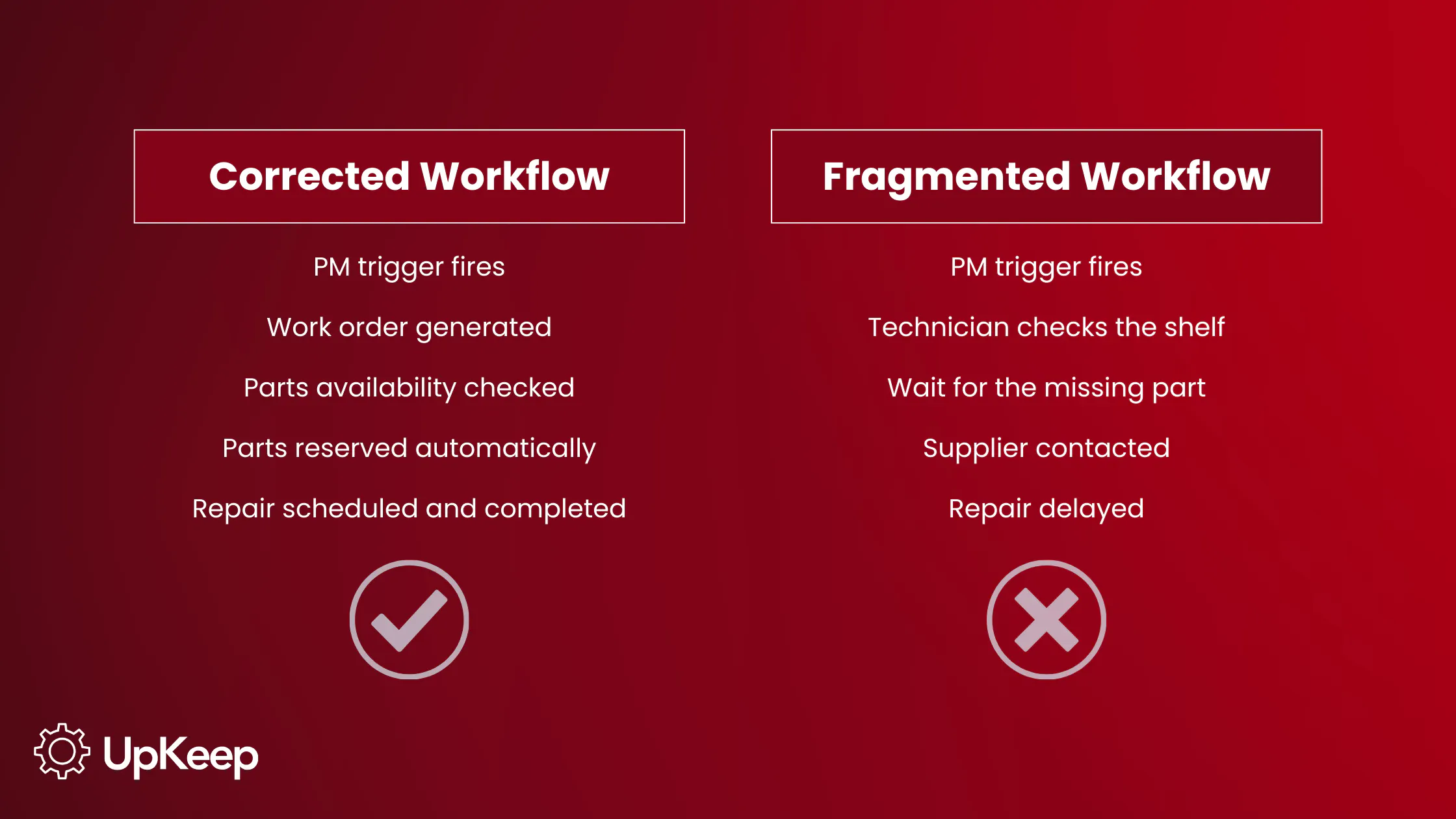
The operational difference between managed and unmanaged inventory shows up in how a repair is executed:
Connected workflow: PM trigger fires → work order generated → system checks parts availability → parts confirmed on hand and reserved → work order assigned and scheduled → repair happens without delay.
Fragmented workflow: PM trigger fires → technician checks shelf → part missing → manager contacts supplier → two-day wait → repair happens late → vehicle downtime extends.
The gap between those two sequences is where unplanned downtime accumulates. A vehicle sitting in the bay waiting on a part isn’t a maintenance problem, but an inventory issue that shows up in the maintenance budget.
Telematics platforms like Samsara and Linxup feed fault codes and diagnostic data into the work order workflow. They pinpoint what requires attention, then the inventory system determines whether the parts needed to act on it are on hand.

What to Look for When Evaluating Fleet Maintenance Parts Inventory Software
Work Order Integration
Inventory tracking that doesn’t connect to work orders is just a warehouse tool. It tracks what’s on the shelf but doesn’t prevent a repair starting without the parts to complete it.
Work order integration is the most important differentiator in this category; everything else builds on it.
Consumption-Based Reordering
Static min/max thresholds set at configuration drift out of alignment as fleet composition and duty cycles change. Consumption-based reordering, however, adjusts to actual usage patterns. As a result, high-use vehicles trigger replenishment faster, seasonal demand shifts are reflected in purchasing, and slow-moving parts don’t accumulate dead inventory.
Mobile Access
Parts lookups and stock checks happen in the shop bay. A system that requires a desktop login to confirm availability will see low technician adoption, which leads to inaccurate data and defeats the purpose of tracking inventory at all.
VIN-Based Asset Setup
Vehicle data auto-populated from VIN lookup reduces setup time and prevents configuration errors that create gaps in PM scheduling. A VIN scan should automatically pull make, model, year, specs, recalls, and warranty data, eliminating the need for manual entry, which can introduce mismatches.
Cost Reporting Granularity
Per-vehicle and per-asset-class reporting synthesize cost data to support replacement planning and budget defense. Fleet-wide totals don’t expose which specific assets are draining the parts budget.
Free Tools: What They Cover and Where They Stop
Some CMMS tools offer free starter tiers, while others provide only free trials for a limited time. Free plans typically include basic parts lists, manual stock tracking, and simple reorder alerts.
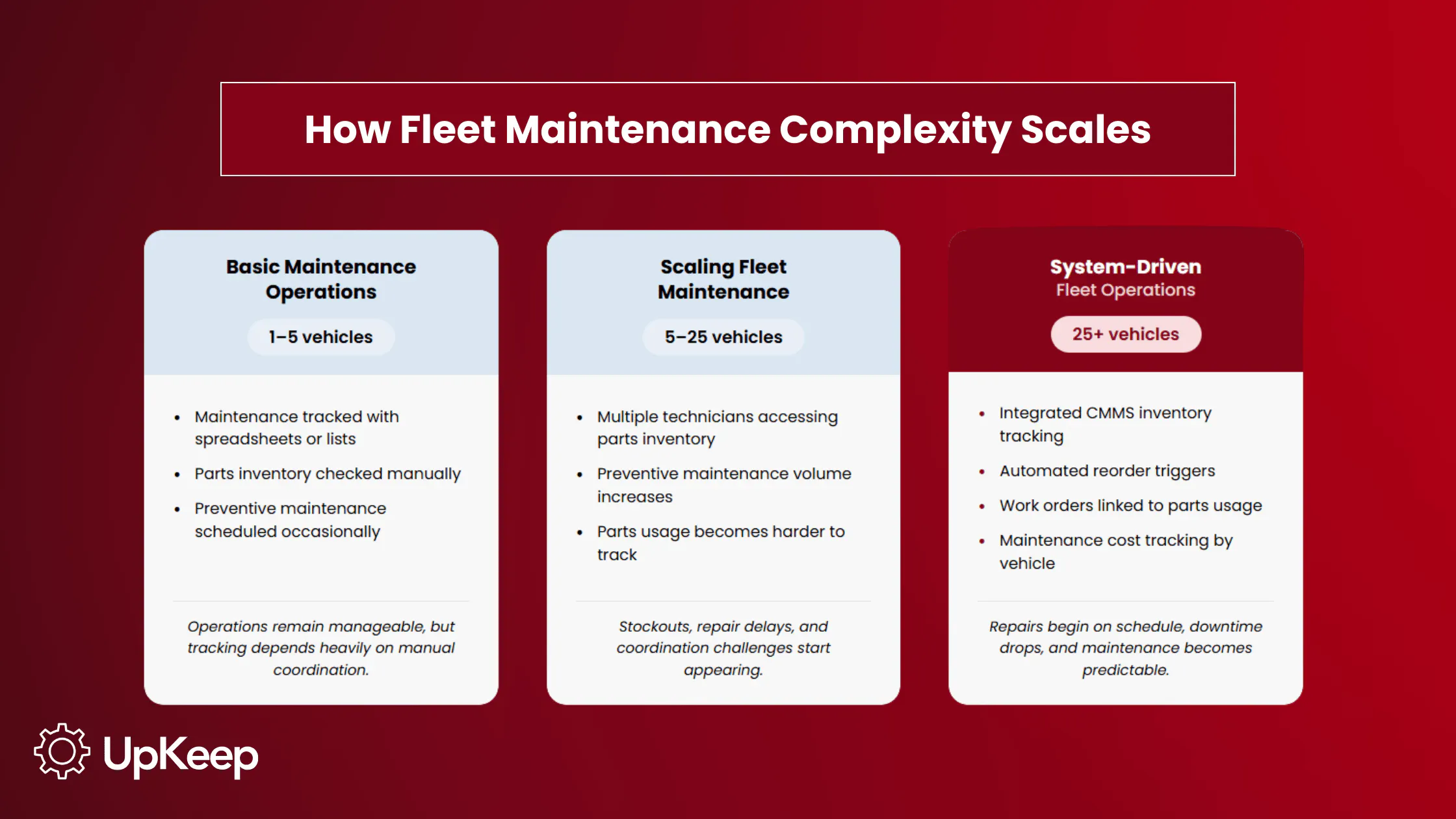
For a five-truck fleet with minimal PM activity, that may be sufficient. But once fleets grow beyond a single technician or location, inventory accuracy begins to depend on manual updates and someone remembering to reorder parts.
Without consumption-based reordering and work order integration, stockouts and repair delays accumulate where manual oversight is the only safeguard.

Fleet Parts Inventory KPIs Worth Tracking
Use these metrics to monitor the parts program's health:
KPI | What It Measures | Why It Matters |
Work orders delayed by missing parts | # or % of work orders held waiting on stock | Direct measure of stockout impact on repair turnaround time |
Parts cost as % of maintenance budget | Parts spend ÷ total maintenance spend x 100 | Exposes budget-draining assets and purchasing inefficiency |
Warranty recovery rate | Warranty claims filed vs. eligible replacements | Quantifies recoverable costs currently being missed |
Inventory turnover | Annual value of parts issued/used at cost ÷ average inventory value | Flags dead inventory and overstocking by category |
From Reactive to Controlled
In a reactive operation, parts are ordered when someone notices they’re gone. Technicians wait on stock while vehicles sit in the bay, and warranty claims go unrecovered because the system doesn’t check coverage at the point of replacement. Parts spend is treated as a line item instead of a per-asset number, and replacement decisions are made on gut feel.
In a controlled operation, though, reorder triggers run automatically based on consumption, and work orders are scheduled only when parts are confirmed to be on hand. Warranty coverage is also consulted before every replacement, while cost reports show which assets are worth keeping and which have crossed the threshold where repair spend outpaces the vehicle’s operational value.
UpKeep centralizes parts inventory alongside work orders, PM schedules, and asset history on one platform, connecting the inventory record to the decisions it should drive, rather than treating it as a separate spreadsheet that nobody updates until a stockout forces the issue.
Ensuring parts availability translates to fewer repairs stalled, faster turnaround, lower MRO spend, and defensible replacement.
Frequently Asked Questions
What is fleet maintenance parts inventory software?
A system that tracks stock levels, consumption patterns, and reorder triggers for a vehicle fleet. It connects to work orders and PM schedules so technicians know what’s available before starting a repair.
How does fleet maintenance parts inventory software reduce vehicle downtime?
Parts are confirmed available before a work order is scheduled, rather than discovering they’re missing mid-repair. The software also automates reorder triggers to avoid stockouts, and work order integration prevents the repair from starting until the required parts are available. Fewer repairs stall, so turnaround time drops.
How is the software different from a general inventory system?
General inventory systems track stock quantities. Fleet-specific systems tie consumption to individual vehicles and work orders, enabling per-asset cost reporting, warranty tracking, and PM-linked reordering that generic tools don’t provide.
Can small fleets benefit?
Yes, even small fleets benefit from tracking parts inventory so common items are available when repairs are scheduled. Basic tools may be enough for fleets with only occasional maintenance. But as the number of vehicles, technicians, or preventive maintenance tasks grows, inventory software is necessary to prevent stockouts, reduce downtime, and keep parts spending under control.
Is there free fleet maintenance parts inventory software?
Yes. Some fleet maintenance tools offer free starter tiers with basic parts lists, manual stock tracking, and simple reorder alerts, and these plans can work for very small fleets. However, advanced capabilities such as consumption-based reordering, deeper work order integration, and multi-location inventory management are typically limited to paid plans.
How does warranty tracking work?
The system links part and vendor warranty records to the parts database. When a replacement is needed, it checks coverage before a purchase order is issued. Warranty-eligible replacements are flagged for claims processing rather than default purchasing.
4,000+ COMPANIES RELY ON ASSET OPERATIONS MANAGEMENT
Leading the Way to a Better Future for Maintenance and Reliability
Your asset and equipment data doesn't belong in a silo. UpKeep makes it simple to see where everything stands, all in one place. That means less guesswork and more time to focus on what matters.






![[Review Badge] Gartner Peer Insights (Dark)](https://www.datocms-assets.com/38028/1673900494-gartner-logo-dark.png?auto=compress&fm=webp&w=336)