Blog Post
Fleet Maintenance Best Practices to Reduce Downtime
Reduce fleet downtime with proven maintenance best practices: usage-based PM, digital inspections, telematics alerts, and cost tracking.



Key Takeaways
Usage-based preventive maintenance reduces unplanned breakdowns and cuts maintenance costs by preventing over- and under-servicing.
Digital DVIRs catch defects early while creating audit-ready compliance records automatically.
Telematics enables real-time fault detection between service intervals, preventing costly failures.
Strategic inventory management eliminates repair delays due to missing parts.
Asset history and KPIs replace guesswork with data-driven repair and replacement decisions.
Fleet downtime directly impacts your bottom line. Every hour a vehicle is off the road means lost revenue, missed deliveries, and unhappy customers asking why their shipment is late.
Most fleet operations spend 70%–90% of their maintenance time reacting to unexpected failures rather than preventing them. This approach creates a cycle of emergency repairs, expedited parts fees, and overtime labor that drains your budget while keeping vehicles off the road.
What Are Fleet Maintenance Best Practices?


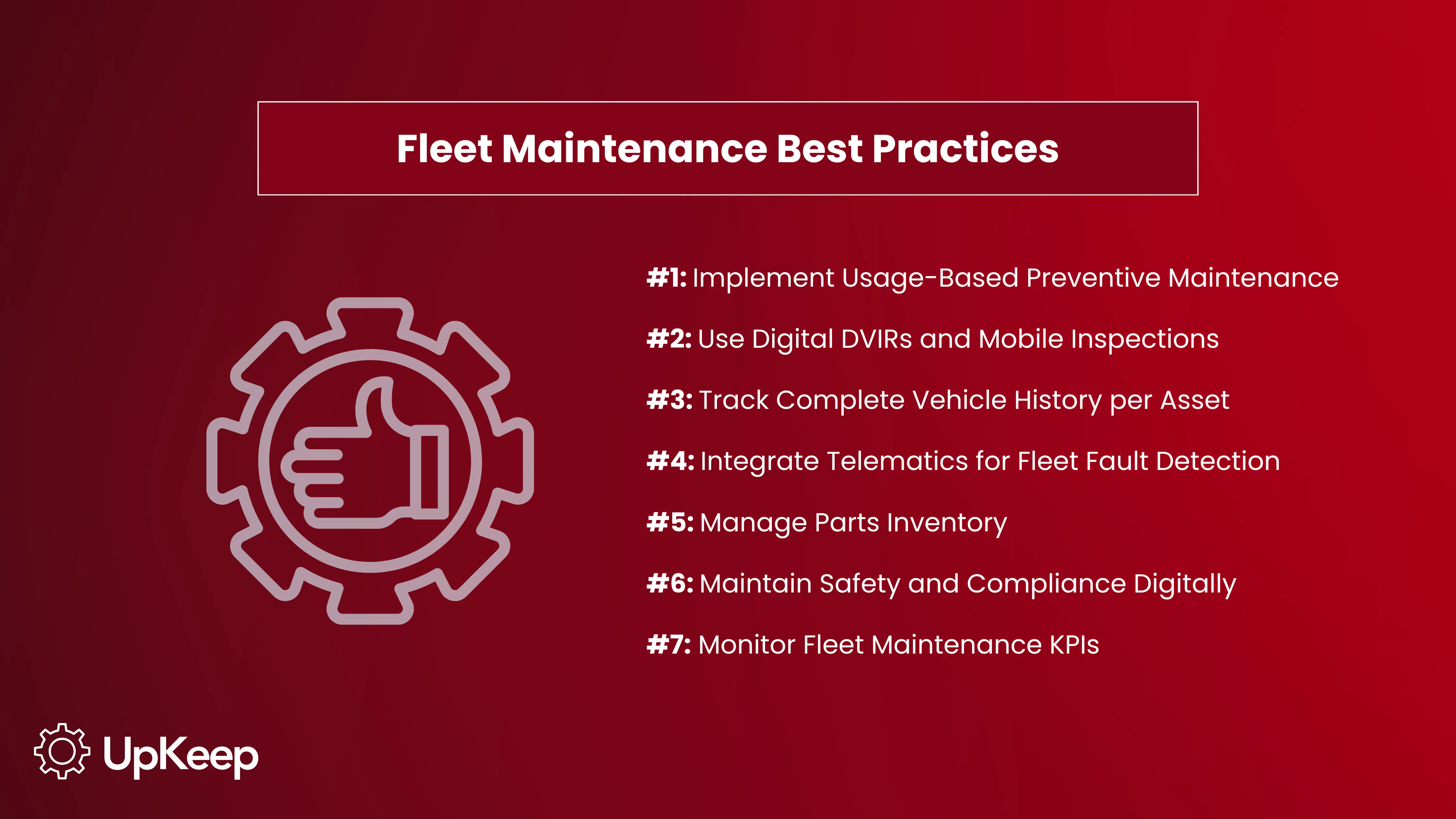
Fleet maintenance best practices help you prevent breakdowns rather than react to them.
A fleet CMMS (computerized maintenance management system) is a key component of this that centralizes inspections, work orders, preventive maintenance (PM) schedules, asset history, and inventory in one system. It helps you catch problems during inspections, when they’re still manageable and inexpensive.
To keep trucks running reliably while controlling costs and extending asset lifespan, follow these recommendations.
Best Practice 1: Usage-Based Preventive Maintenance for Fleet Vehicles

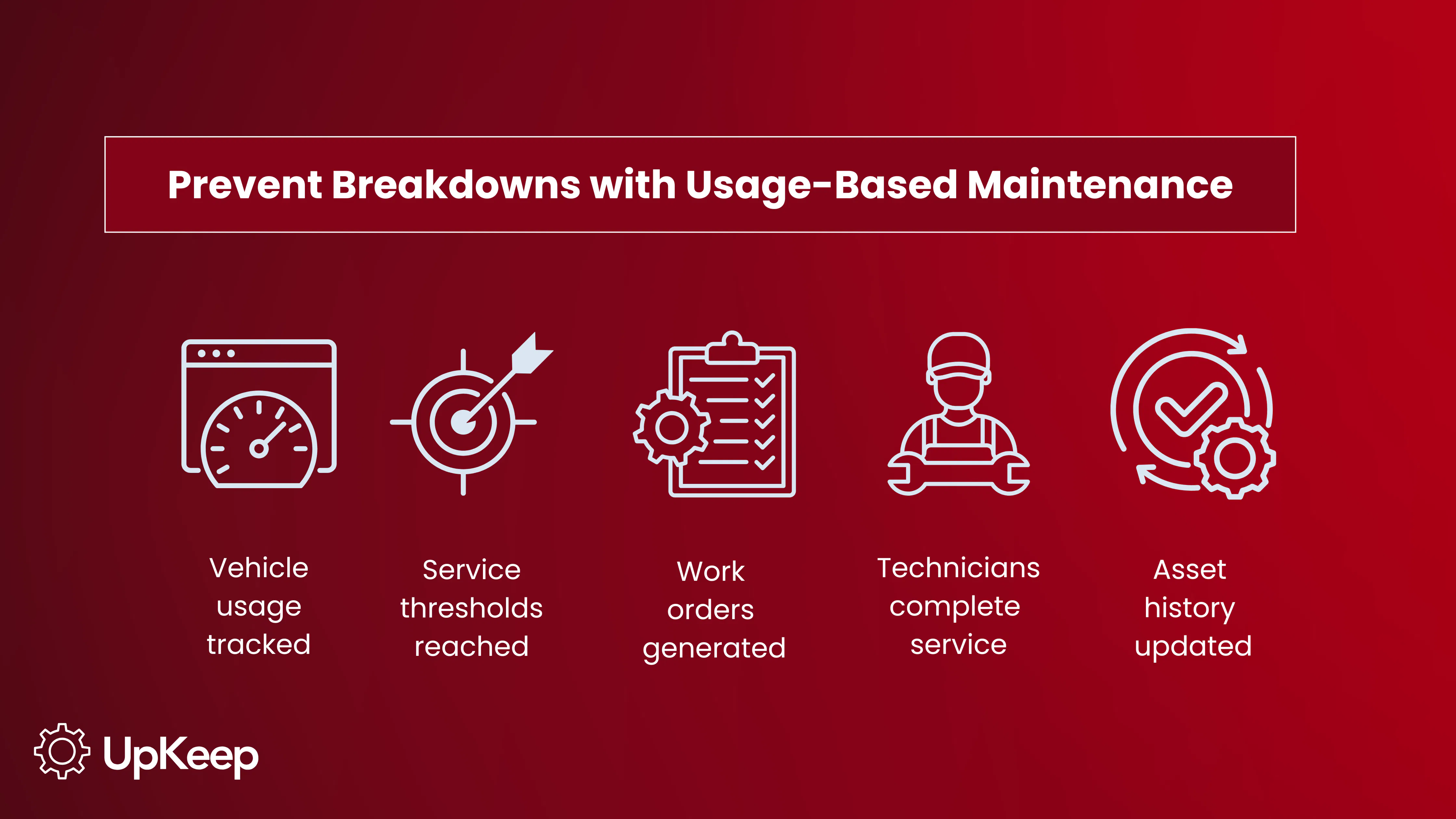
Usage-based PM schedules service based on vehicle wear, mileage, and engine hours, rather than arbitrary calendar dates.
This ensures high-use delivery vans receive the aggressive service intervals they need while preventing unnecessary maintenance on lesser-used vehicles. A delivery van that runs 200 miles per day requires checks more frequently than a truck that travels 50 miles per week.
Most systems automatically generate work orders when trucks reach configured thresholds, such as oil changes at specified mileage intervals or tire rotations based on wear.
Metrics to track: PM completion rate and emergency breakdown frequency.
Best Practice 2: Use Digital DVIRs and Mobile Inspections
Digital driver vehicle inspection reports (DVIRs) help you catch defects during pre-trip inspections and prevent unexpected roadside breakdowns.
Before they leave the lot, drivers complete inspection checklists and log any issues they notice, such as worn brakes or fluid leaks, on a mobile device. Many DVIR apps work offline in areas with poor cell coverage and sync when connectivity returns.
Most digital DVIR systems then create work orders with timestamps and photos to meet Federal Motor Carrier Safety Regulations and provide the audit trails required by DOT inspectors. With no lost paperwork or delays in reporting, logged issues can be repaired early before they snowball into major problems.
Metrics to track: Number of defects caught before breakdowns and average time from detection to resolution.
Best Practice 3: Track Complete Vehicle History per Asset
Complete vehicle history tracking reduces total ownership costs by providing the data needed to make objective replacement decisions instead of relying on gut feel.
You can add vehicles to your CMMS using VIN lookup so the system will auto-populate the make, model, year, and specifications instantly, eliminating manual data entry.
Every maintenance event, from tire replacements to oil changes, is logged automatically, along with labor hours, parts costs, and downtime duration. That detailed insight reveals which vehicles consistently drain budgets, and which deliver predictable costs below fleet averages.
Metrics to track: Cost per truck, repeat failure patterns, and repair vs. replace frequency.
Best Practice 4: Telematics Integration for Real-Time Fleet Fault Detection
While scheduled PM prevents wear and tear from standard use, telematics monitors vehicle health in real time to catch unexpected faults before they turn into operational disruptions. Both practices work together to minimize vehicle downtime and reduce emergency costs.
Connect telematics and sensors to your CMMS or integrate with platforms like Samsara or Azuga to trigger maintenance alerts when issues first arise. The system then generates work orders that include location and specific fault code details.
Metrics to track: Emergency repairs avoided and downtime hours reduced.
Best Practice 5: Manage Parts Inventory Strategically
Strategic parts inventory management eliminates repair delays by keeping technicians stocked with the most-needed parts.
To understand your fleet’s usage patterns, track which parts are frequently in demand across your fleet, and monitor your purchases to see which components drive the highest costs. You can then configure your fleet maintenance management system to automatically flag low inventory levels and trigger purchase orders when quantities drop. This will keep common items on hand without constant manual oversight so routine maintenance doesn’t grind to a halt over a missing part.
Metrics to track: Work orders delayed by missing parts and parts cost as a percentage of total maintenance budget.
Best Practice 6: Maintain Safety and Compliance Digitally
Digital compliance management protects your fleet in two ways: It prevents unsafe vehicles from leaving the yard and eliminates DOT violations by automating your paper trail.
Beyond daily inspections, you can monitor manufacturer recalls by linking NHTSA data directly to your VINs. This addresses safety issues before they become dangerous to drivers.
Eliminate the guesswork of manual tracking by setting automated reminders to alert you when inspections are due, certifications are about to expire, or recalls require action.
When a DOT auditor requests 90 days of pre-trip inspections, you won’t need to scramble through filing cabinets. Instead, you simply open the online system, filter by date range, and export a comprehensive and compliant report.
Metrics to track: On-time inspections, DOT violations, and recall response time.
Best Practice 7: Monitor Fleet Maintenance KPIs That Reduce Downtime and Costs

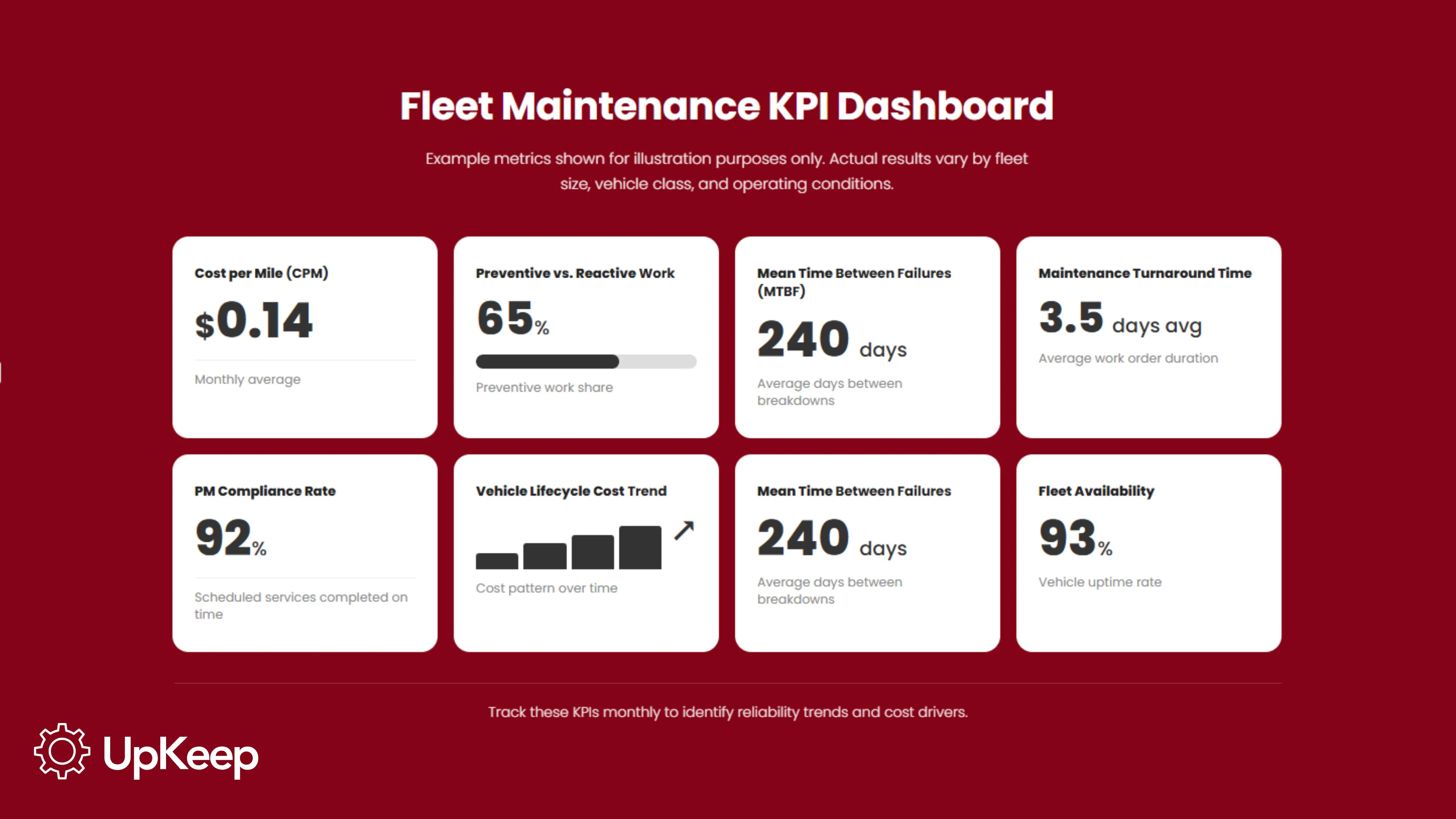
Tracking key maintenance metrics proves program ROI and identifies problematic vehicles by providing the data needed to justify budgets and guide replacement decisions.
Monitor these core indicators to expose the true cost of your fleet:
Cost Per Mile (CPM)
This is your financial baseline. Industry benchmarks run $0.08–$0.12 per mile for light trucks, $0.12–$0.18 for medium-duty, and $0.15–$0.25 for heavy-duty. Compare each vehicle against your fleet average to spot budget-drainers.
Preventive vs. Reactive Ratio
Aim for 80% preventive, 20% reactive. Many fleets today operate closer to 50/50, which means constant firefighting. Best-in-class operations drive reactive work below 10%.
Mean Time Between Failures (MTBF)
This is the primary measure of reliability. Rising MTBF proves your PM program is working. Well-maintained fleets typically see over 300 days between failures, while less-mature operations average 120–200 days.
Maintenance Turnaround Time
This measures shop efficiency from work order to return to service. Spikes expose workflow bottlenecks, such as parts shortages, understaffing, or slow approvals.
PM Compliance Rate
Scheduled service must happen on time, so aim for above 95% completion. Low compliance is a leading indicator of future breakdowns.
Vehicle Lifespan
This KPI is how you validate long-term ROI. Maintenance costs typically climb from $0.03–$0.05 per mile in years one to two to $0.25 and more after year nine. Track service life to identify when aging assets become too expensive to maintain.
Uptime Percentage
This might be your most critical measure. Target vehicle availability above 95%, which translates to only a few days of downtime per vehicle each year.
Additional metrics: Recall response time (how quickly you address manufacturer safety recalls), first-time fix rate (repairs completed correctly on the first visit), and inventory turnover (parts usage efficiency).
Pro Tip: Create a monthly dashboard showing CPM trends, your preventive-to-reactive ratio, and MTBF to provide leadership visibility. Share this during budget reviews to demonstrate the value of the maintenance program and justify budget requests.
Industry-Specific Fleet Maintenance Considerations
One-size-fits-all fleet maintenance doesn’t work. Each industry exerts unique stresses on vehicles that require specific attention:
Delivery & Last Mile
The major challenge here is distance. Stop-and-start traffic on shorter drives accelerates brake and transmission wear faster than highway driving for longer distances. These vehicles often require stricter maintenance schedules that prioritize cooling systems and brakes over standard mileage intervals.
Construction & Heavy Equipment
These assets face environmental warfare. Rough terrain demands rigorous undercarriage and suspension inspections to catch structural cracks early. Heavy dust also necessitates frequent air filter changes and radiator cleanouts to prevent the engine from choking or overheating.
Field Service
Field service vehicles often serve as mobile offices, so technicians need remote access to vehicle history to make repair decisions on the road. Additionally, because the vehicle represents the brand to the customer, exterior maintenance (i.e., body and paint) is as critical in this industry as mechanical health.
Refrigerated Transport (Cold Chain)
The food and medical industries commonly manage both a truck and a fridge unit that requires a PM schedule completely separate from the chassis. Here, real-time temperature monitoring is your primary defense against cargo spoilage and compliance violations.
Sustainable & Green Fleets
Tune-ups look completely different for electric vehicle (EV) fleets, moving from oil changes to monitoring battery state of health (SOH) and charging-system efficiency. Maintenance teams must aggressively monitor idle time and fuel trim data.
How to Implement Fleet Maintenance Management System Best Practices
Add vehicles to your CMMS system using VIN lookup and auto-populate them with relevant data.
Establish baseline metrics over 30 days. Track current breakdown frequency, PM completion rate, and cost per mile.
Configure usage-based PM triggers based on manufacturer recommendations and actual duty cycles.
Train drivers on mobile DVIR completion, defect logging procedures, and reporting requirements.
Integrate telematics platforms to enable fault-to-work-order workflows and real-time condition monitoring.
Review metrics frequently. This entails operational indicators to catch issues early, performance trends to identify patterns, and strategic planning for replacement cycles.
Adjust PM intervals, parts inventory levels, and staffing allocations based on your data on maintenance needs and operational patterns.
CMMS Software Turns Fleet Maintenance Into a Controlled Operation
These best practices work together to shift fleet maintenance from constant firefighting to predictable procedures.
Usage-based PM prevents failures before they happen, while digital inspections help you catch problems early. Vehicle history shows which trucks drain budgets, and telematics alerts you to issues before they turn into real problems. Finally, parts inventory keeps repairs in motion, while metrics show what's working and what needs improvement.
Modern CMMS platforms centralize these workflows. Instead of juggling spreadsheets and separate tools, you can manage trucks, warehouse equipment, and facilities in one place. This yields fewer unexpected breakdowns, faster repairs, lower ownership costs, and reliable service delivery that protects customer commitments and revenue.
Frequently Asked Questions
How often should fleet vehicles be inspected?
Federal regulations (FMCSR Part 396) require annual inspections for all commercial vehicles, plus daily pre- and post-trip inspections to ensure safety. High-use delivery trucks benefit from more frequent internal inspections, while those that see lower use need them less frequently. Use runtime data to customize frequency based on vehicle duty cycle.
What’s the ROI of preventive maintenance for fleets?
Preventive maintenance helps fleets reduce costs, minimize downtime, and extend vehicle lifespan. Industry benchmarks suggest cost reductions of 18%–30%, daily downtime losses of hundreds per vehicle, and uptime rates consistently above 95% in well-maintained fleets.
How do I track fleet maintenance costs effectively?
Calculate CPM monthly using the formula: total maintenance spend ÷ miles driven. Compare each vehicle against the fleet average. Trucks significantly above it are candidates for investigation or replacement. Be sure to track your parts purchasing frequency separately to identify which components drive the highest costs.
What are the most important fleet maintenance KPIs?
CPM, preventive vs. reactive ratio, MTBF, maintenance turnaround time, vehicle lifespan, PM completion rate, and uptime percentage are the most important KPIs to monitor. Track them monthly to identify trends and prove program value.
Can small fleets benefit from CMMS software?
Yes. Even 5-10 truck fleets can benefit from CMMS software. Small fleets operate with less margin for error, so a single breakdown can severely disrupt customer commitments.
Why does mobile-first CMMS matter for fleet operations?
Technicians work in shop bays, not at desks, while drivers complete inspections soon before leaving yards. Mobile platforms can secure high adoption rates because they match how work occurs, namely, creating DVIR records on-site, receiving work orders on phones, and accessing vehicle history from the shop floor.
4,000+ COMPANIES RELY ON ASSET OPERATIONS MANAGEMENT
Leading the Way to a Better Future for Maintenance and Reliability
Your asset and equipment data doesn't belong in a silo. UpKeep makes it simple to see where everything stands, all in one place. That means less guesswork and more time to focus on what matters.






![[Review Badge] Gartner Peer Insights (Dark)](https://www.datocms-assets.com/38028/1673900494-gartner-logo-dark.png?auto=compress&fm=webp&w=336)