Blog Post
Enhanced Preventive Maintenance Is Key to Food Safety
Enhanced preventive maintenance can prevent food safety issues from occurring, and can increase a company's confidence in its quality and food safety programs.


For most manufacturing companies, no matter what they make, preventive maintenance is all about keeping equipment running. This includes providing scheduled, targeted maintenance before there is a breakdown that can stop production. This is, of course, necessary―but not sufficient in the food and beverage industry. Enhanced preventive maintenance (EPM) can prevent food safety issues from occurring, and can also increase the company's confidence in its quality and food safety programs.
Enhanced means including and engaging the maintenance team as an equal partner in food safety, along with including food safety needs in priority setting for the maintenance team. These enhancements reduce the risk of getting a consumer ill or injured, reduce the risk of adverse regulatory actions by FDA or USDA (and state health authorities), and increase the confidence of customers and consumers in the company's products. To these ends, let's discuss some of the ways a company can execute an EPM program with the right priorities. Doing so effectively will also have the highly desirable outcome of improving the odds of a successful SQF (Safe Quality Foods) audit.
In my many decades of working in food manufacturing facilities (including as a Plant Manager and as a VP of Operations), I worked with companies that struggled with SQF audit successes and regulatory inspections, and I worked with companies that had smooth sailing in those regards. Perhaps not coincidentally, the former had maintenance departments that focused solely on keeping equipment running, while the latter had maintenance departments that integrated themselves into the company's overall Food Safety Plan.
What is a Food Safety Plan? The FDA defines it as a "…systematic approach to the identification of food safety hazards that must be controlled to prevent or minimize the likelihood of a foodborne illness or injury." Such a plan is now required by law (the Food Safety Modernization Act) – note the use of the word "prevent" in the definition. Seems like "preventive maintenance" is important to everyone!
What Is Preventive Maintenance?
It is absolutely, critically important that plant equipment be kept running. By not having this occur, operations can be compromised, made inefficient, or worse, the plant could stop producing food. Hence, everything in this article is meant to be supportive of that primary function of the maintenance department.
This important objective is why maintenance organizations exist, and it is built into almost all definitions of preventive maintenance (PM). An excellent source of information is this website, along with the support that the UpKeep team provides with its maintenance technologies and systems. Here is a definition of preventive maintenance provided by UpKeep: "proactive maintenance…that keeps assets in good order and reduces unscheduled downtime and major repairs." The site also provides an excellent overview of FDA requirements with regard to maintenance. The agency is not prescriptive in how the maintenance department should be structured or run, but it does provide many requirements on the outcome and expectations of their work!
Similarly, USDA has its own set of maintenance requirements, as its inspectors use a set of Sanitation Performance Standards to assess a company's compliance.
It is very important to note that both FDA and USDA use a broad scope for their definition of maintenance. It is not just "equipment,” but essentially includes the entire facility (e.g., walls, ceilings, HVAC). Of course, maintenance departments already include the entire facility in their functional scope. This is mentioned rather for the fact that FDA and USDA are also looking for how areas of disrepair in a facility (including equipment) might introduce a hazard into the food that is being produced. By way of example, if a ceiling area over a production zone is clean, well-sealed, and well-lit, but has a ceiling support junction that has a tendency to accumulate water (e.g., from condensation during the summer) which could drip onto food below, then FDA or USDA will consider this a noncompliance with their regulations.
Tip: Think about "maintenance" in THREE dimensions – what you can TOUCH, what you can HEAR, and what you can SEE.
Maintenance: Upon-Design, Scheduled, and Reactive
There are other types of maintenance that can affect a company's ability to avoid risks and hazards in its operations.
Upon-Design maintenance, very often underestimated, refers to the intellectually strategic work that goes into the design and construction of a piece of equipment prior to its actual use. To this end, there are a number of parameters that always are (or should be) considered. These include cost, lead time, ability of a supplier to perform in a quality and ethical manner, materials of construction, footprint, utilities needed, and ability of the equipment to be serviced/repaired. There is one more item for the purposes of this article, however: sanitary design input. With the likely consequence of higher cost, this type of equipment design should favor materials of construction, cleanability, accessibility, and overall design which will allow the equipment to be sanitary as made and throughout its years of operation.
An excellent set of principles for sanitary equipment design is provided by the American Meat Institute Foundation (“Sanitary Equipment Design Principles") in which the primary principle is to design and construct the equipment "…to prevent bacterial ingress, survival, growth, and reproduction on both product and non-product contact surfaces of the equipment." This is an excellent definition of "sanitary."
Tip: From a food safety point of view, put time and money into proper sanitary equipment design on the front end. This strategy will easily pay for itself down the line.
Scheduled maintenance is what typically makes up the majority of a PM program, and is therefore often considered a synonym for preventive maintenance. There are many ways to develop, execute, and track a schedule, but the important thing to keep in mind is that such plans are only as good as the thinking and data that go into them. You cannot rely on the software to make sure that all your equipment is running at top efficiency or not causing food safety hazards. The best schedules are evolving, taking into account changes in a facility's volume, seasonality, and other factors which might cause a failure sooner or later than originally anticipated. Over time, enough data can be compiled to drive an accurate scheduled maintenance plan.
Reactive maintenance is exactly what it is espoused to be―something failed unexpectedly, and the maintenance department now needs to react, typically in an urgent manner. These types of instances cannot be avoided―they are a fact of life in a plant―yet learning from these situations to improve the overall PM (scheduled) program will help to minimize these deviations and plant downtime. They may even lead to improvements in design and operation.
Maintenance: Enhanced
The three PM programs detailed above can, for the most part, be carried out solely by the maintenance department. In fact, in most companies, this is indeed the charter of that department, and most companies are content (and successful) at letting maintenance operate independently in terms of PM. (Maintenance must obviously work closely with operations/production day-to-day.)
In food companies, however, there should also be an "enhanced" PM program. This enhancement is embodied in three key principles:
Preventive maintenance must include activities to prevent or minimize food safety risks.
The maintenance department should be actively involved in control of food safety (i.e., hazard identification and risk management).
Food safety needs must be incorporated into the priority setting (e.g., scheduled maintenance) of the maintenance department.
But don't just take my word for this: if your food company is following a third-party audit scheme such as SQF (Safe Quality Foods) or BRC (British Retail Consortium), these rules also require an EPM program even though they do not use that term directly. The SQF Code (version 8.1, sections 11.2.9 & 10) requires that "equipment…be constructed, installed, operated, and maintained…not to pose a contamination threat to products."
Furthermore, SQF requires that "the maintenance schedule shall be prepared to cover building, equipment and other areas of the premises critical to the maintenance of product safety and quality." Note that neither of these clauses speaks to operability and efficiency of that equipment―it's all about preventing contamination of the food, i.e., avoiding food safety hazards.
Similarly, the BRC Code (Issue 8, Clause 4.7) requires "an effective maintenance programme…to prevent contamination…." The BRC furthermore states that "…where there is a risk of product contamination by foreign bodies arising from equipment damage, the equipment shall be inspected at predetermined intervals…." Again, the focus is on prevention of food safety hazards, including those from foreign material. See the example below on this topic, also.
By complying with the SQF or BRC Codes relative to maintenance, you can significantly increase your audit readiness and your audit scores.
The Maintenance Team Is Great at Hazard Identification
A key tenet of an effective Food Safety Plan (see introduction) is a system that can actively and accurately identify hazards in the plant. Clearly, some of the hazards relate to the people component of operations, and they also relate to the equipment assets. Who better to know that a piece of equipment is working effectively than maintenance? Okay, the operators know too, since they are regularly involved with using equipment to get their job done!
Hence, what better team to form than partnering operators with maintenance technicians? Operators experienced with a piece of equipment can quickly identify when it is working differently, even in small ways. Since there is pressure on the operators to "keep moving" (it's their job, of course), often this pressure works insidiously to keep operators from informing their supervisors and/or the maintenance team―let alone taking the drastic step of shutting the equipment down to do so.
This dynamic needs to be addressed in an EPM program. It is beyond the scope of this article to provide details on how to do so, but you should recognize that this is a most important touchpoint in equipment-related food safety risk management. Said another way, ensuring regular information flow from line operators to maintenance is critical to a forward-thinking EPM preventive maintenance program.
Once maintenance has been notified of an operator observation, they are highly capable of diagnosing the issue, e.g., quick-fix, or a sign of trouble to come. This needs to be brought to food safety leadership, which should include the executive leadership of the company, so that operational requests do not always supersede maintenance requests. Empowering the maintenance organization in this regard is very powerful at allowing them to help the company avoid food safety hazards.
Priority-Setting for Maintenance
The maintenance PM schedule drives the vast majority of the day-to-day work of that team. Hence, food safety needs must be integrated seamlessly into the schedule. Food safety needs should not just be an add-on. We all know that "add-on" work typically gets relegated to the sideline ("when we have more time, perhaps next weekend"). As short-term and long-term hazards are identified, and the risks associated with them are delineated, then the potential impact on the business can be defined. This impact is predominantly influenced by the ability to cause harm to the consumer and/or by how frequently this might occur. These factors can easily be overlooked or at least overshadowed by other important business parameters such as cases per hour or downtime.
Once again, executive leadership plays a key role in ensuring that priorities are set cross-functionally and are consistent with the business's values and financial needs. The best decision sometimes is to pull a piece of equipment out of service, so that it can be redesigned with sanitary design additions/improvements.
Tip: Executive leadership plays a key role in making sure maintenance is integrated into business planning and with the quality/food safety department.
Let's now study some examples of "hidden" maintenance needs. These are observations made by non-maintenance personnel, which can have a high impact on food safety risk.
Simple Observations Can Identify Maintenance-Related Food Safety Risks
Here are some examples of what may not seem like maintenance issues at first blush, or at least not very important or urgent ones:
Temperature Control of Coolers
Production personnel putting food into a cooler and/or taking it out will be the first to notice that the device may be making items too cold, or may be taking longer than usual to get them to a desired temperature (e.g., 40 °F for retail deli salads). Although the production people may dutifully record temperatures, telling maintenance about a deviation could avoid food that is not cooled enough (a direct food safety issue because of bacterial growth) and/or keeping substantial condensate from forming inside the device (also a food safety issue if that condensate drips onto open food).
Residual Food on a Mixer Shaft
Preoperational inspections are common if not required prior to a shift starting up. A good pre-op team becomes expert at noticing whether or not a piece of equipment has been reassembled properly, and if there is any food residue on any of the moving parts. If there are bacteria on that food, and that spoiled food falls into a clean, fresh food product, then once again there is a food safety issue. A common "fix" is to wipe the dirty shaft clean, but a better step is telling maintenance―this could be a sign of a leaking seal―or reminding the sanitation or production team who assembles the equipment that their training is lacking.
Gearbox Cover
Opening the cover of the gearbox for some equipment is extremely difficult because of its design (it is bolted on, for example). As a result, it does not get opened on a regular basis. A good pre-op team will eventually remove the cover, likely to find all kinds of spoiled food and "goo" on the inside covering the large gears. Again, cleaning the gears makes sense, but even better is letting maintenance know. They might be able to design some shields for those gears, or even pull the equipment out of active service in order to redesign the gear protection and/or retrofit an easily-removed hatch.
Metal Detectors/X-Ray Machines/Optical Readers
Preventing foreign materials (plastic, glass, stones) from getting into food is critical to food safety (choking). USDA, for example, will almost assuredly require a recall if plastic pieces get into retail food containers. The production personnel who spend their day at an x-ray machine (for example) know that during their shift if the machine is working normally―however, they may see more false positives than usual. And although this may seem fine (since the line and product will be checked at those times), this also indicates that something is amiss with the electronic settings on the machine (and/or perhaps the density of the food being checked has changed due to a formulation adjustment). Either way, this should be reported to supervisors and to maintenance, so that a proper investigation and remedy can be executed.
With proper cross-functional communication, recalls can be prevented. By not doing so, you risk having your company showcased publicly for a faulty PM program. Unfortunately, this happens all the time. Case in point: in December 2020, USDA made a very well-known international food company recall over 90,000 pounds of their baked chicken meal products because the meals may have been contaminated with pieces of white hard plastic. Don't you think it's possible with an EPM program that someone might have noticed an early failure and started the proper preemptive communication of this food safety risk?
Tip: Make sure that operations/production floor personnel are part of a very robust training program. A well-designed EPM program will still fail if the people operating the equipment don't really know how the equipment is supposed to work.
The above examples will not apply to everyone. But the point is that seemingly small observations by hands-on personnel are the foundation of a powerful EPM program. Building the right communication channels independent of functional silos or impact on the immediate operation can go a long way to prevent a hazard from turning into a major food safety risk or recall.
Conclusion
For safe foods, the authorities (regulatory and third-party certification bodies) are saying the same thing: preventive maintenance is more than just keeping equipment running. Having an "enhanced" program, an EPM program, is necessary―and required―to prevent food safety hazards and risks. To be successful, consider these suggestions:
Design, build, and operate equipment for microbiological cleanliness.
Include and engage the maintenance department as part of the company's food safety team.
Include and engage production floor operators and pre-operational inspection teams with maintenance partners to foster two-way communication.
Ensure cross-functional collaboration and accountability in partnership with the executive team.
Set priorities for food safety as a company, not just with the quality assurance/food safety department.
The foundation for an effective EPM program is diagrammed below.


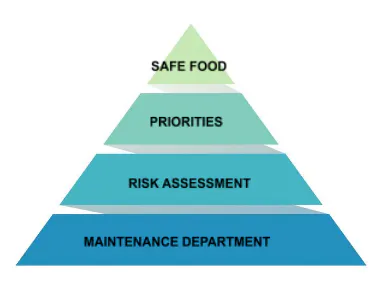
Creating an enhanced preventive maintenance program is tantamount to decreasing food safety risk. And as everyone knows, an ounce of prevention…allows everyone to maintain less stress!
Want to keep reading?



Article
How To Build an Efficient Preventive Maintenance Checklist



Article
How to Implement a Preventive Maintenance Program


Article
Why Is Preventive Maintenance Cost Effective?
4,000+ COMPANIES RELY ON ASSET OPERATIONS MANAGEMENT
Leading the Way to a Better Future for Maintenance and Reliability
Your asset and equipment data doesn't belong in a silo. UpKeep makes it simple to see where everything stands, all in one place. That means less guesswork and more time to focus on what matters.






![[Review Badge] Gartner Peer Insights (Dark)](https://www.datocms-assets.com/38028/1673900494-gartner-logo-dark.png?auto=compress&fm=webp&w=336)