Blog Post
From Reactive to Audit-Ready: The Role of CMMS in Compliance
Transform your maintenance compliance with CMMS software. Automate inspections, centralize audit logs, and easily meet OSHA, FDA, and ISO standards.



Key Takeaways
Failure to adhere to maintenance standards creates severe operational risks, ranging from workplace safety hazards and fatalities to significant legal fines and reputational damage.
Transitioning from manual records to a computerized maintenance management system (CMMS) creates a single source of truth that ensures all asset history, repair logs, and safety documentation are centralized, searchable, and audit-ready.
Modern CMMS platforms enforce regulatory standards through automated preventive maintenance scheduling and mandatory digital checklists, eliminating the human error and variability associated with paper-based systems.
Features such as time-stamped activity logs and secure user permissions provide the irrefutable evidence and audit trails required by strict regulators like OSHA, ISO, the FDA, and the EPA.
Compliance in maintenance operations involves the adherence to laws, regulations, and industry standards designed to keep equipment and facilities safe, reliable, and environmentally sound. In high-stakes sectors like heavy manufacturing, healthcare, and aviation, compliance is a fundamental operational and legal requirement.
Risks of Non-Compliance With Maintenance Standards
According to a study by Global Scape and Ponemon Institute, the cost of non-compliance is almost three times that of compliance. Failure to meet maintenance standards creates a dangerous ripple effect across an entire enterprise. Poor compliance is often a signal of a reactive maintenance culture where equipment is more likely to fail unexpectedly and cost the organization thousands or even millions of dollars.
The fallout from neglecting compliance requirements can be catastrophic and affects every level of a company.
Safety Hazards and Fatalities
The most severe risk of non-compliance is physical harm. Neglecting regulatory requirements often leads to run-to-failure scenarios that put human lives in jeopardy. Faulty maintenance was a primary factor in disasters like the Deepwater Horizon spill and various aviation accidents.
Legal and Financial Penalties
Regulatory bodies can impose massive fines for non-compliance. They also come with other indirect costs, such as litigation and insurance premiums that drain the coffers.
Operational Downtime
Inspectors will enforce shutdowns for non-compliant assets. This unplanned downtime is far more expensive than the cost of the preventive maintenance (PM) that would have ensured the asset passed inspection.
Reputational Damage
Company safety records are public knowledge, so a major compliance failure can lead to a loss of consumer trust, difficulty in hiring talent, and a drop in shareholder value.
The Role of CMMS in Compliance Management
A computerized maintenance management system (CMMS) serves as the digital overseer for regulatory compliance in modern industrial environments. This tool automates equipment tracking and inspection scheduling and provides real-time data analytics to transform compliance into a repeatable, daily operation. Organizations in highly regulated sectors use these systems to manage risks, protect their workforce, and provide irrefutable evidence of due diligence during inspections.
Manual Records to Digital Systems
The transition from paper logs and spreadsheets to a digital CMMS addresses the inherent flaws of manual recordkeeping, such as lost forms, illegible handwriting, and siloed data. Digitizing maintenance management centralizes information into a tamper-proof system that keeps documentation readily available for audits.
CMMS as a Single Source of Truth
A CMMS unites all maintenance, asset, and inventory data into one database to produce a single authoritative source of information. Auditors benefit from a clear, time-stamped history of every repair, inspection, and asset modification without searching through filing cabinets or disparate spreadsheets. This centralized model ensures field technicians, supervisors, and executives all work from the same accurate data, fostering a culture of openness and faster decision-making.
Core Compliance Features in a Modern CMMS
Modern CMMS platforms go beyond simple task management to become robust compliance engines. These systems integrate specific features designed to enforce regulatory standards, maintain data integrity, and prove due diligence during audits.
Preventive Maintenance Scheduling
Automated scheduling means critical equipment checks occur at required intervals, eliminating the risk of missed tasks. Teams can set time-based or meter-based triggers that automatically generate work orders, ensuring equipment remains within compliant operating ranges.
Digital Work Orders
Digital work orders serve as the primary evidence of compliance, capturing exactly who did what and when. Technicians document their work in real time through mobile apps, attaching photos and notes that validate the task was completed according to standards.
Standard Operating Procedure and Checklist Management
Standard operating procedures (SOPs) and mandatory checklists guide technicians through every step of a compliance task. Managers can enforce digital checklists that prevent a work order from being closed until every safety step and measurement is verified. This drives consistency across shifts and locations, which avoids variations that often lead to violations.
Asset History and Life Cycle Tracking
A complete asset life cycle history provides auditors with a clear view of equipment health from installation to decommissioning. Centralizing this data allows organizations to prove that every asset has received the necessary care to operate safely and efficiently. It produces a permanent record of all repairs, parts used, and downtime events associated with a specific machine.
Audit Trails and Activity Logs
Digital audit trails automatically record every system interaction to create immutable proof of compliance. This feature tracks user logins, data edits, and status changes so no record can be altered without leaving a digital footprint. In highly regulated industries, that capability is essential for proving the integrity of maintenance data.
Reporting and Compliance Dashboards
Customizable dashboards visualize compliance gaps and upcoming deadlines in real time. Maintenance leaders use these insights to spot overdue tasks instantly and generate comprehensive reports for external auditors with a single click.
Document Management
Secure cloud storage organizes manuals, safety certifications, and warranty documents directly within the asset record. Technicians thus access the most current safety documentation immediately in the field, preventing errors due to outdated information.
User Permissions and Role-Based Access
Granular permission settings control who can view, edit, or approve sensitive compliance data. Administrators assign specific roles to ensure only qualified personnel can sign off on critical safety inspections or modify system configurations. This separation of duties is a key requirement for many safety and quality standards.
Common Compliance Standards Managed Through a CMMS
A robust CMMS acts as a central governance tool, helping organizations navigate a complex web of regulatory requirements. The following sections outline the primary compliance standards that companies can manage through the platform.
Occupational Safety and Health Administration (OSHA)
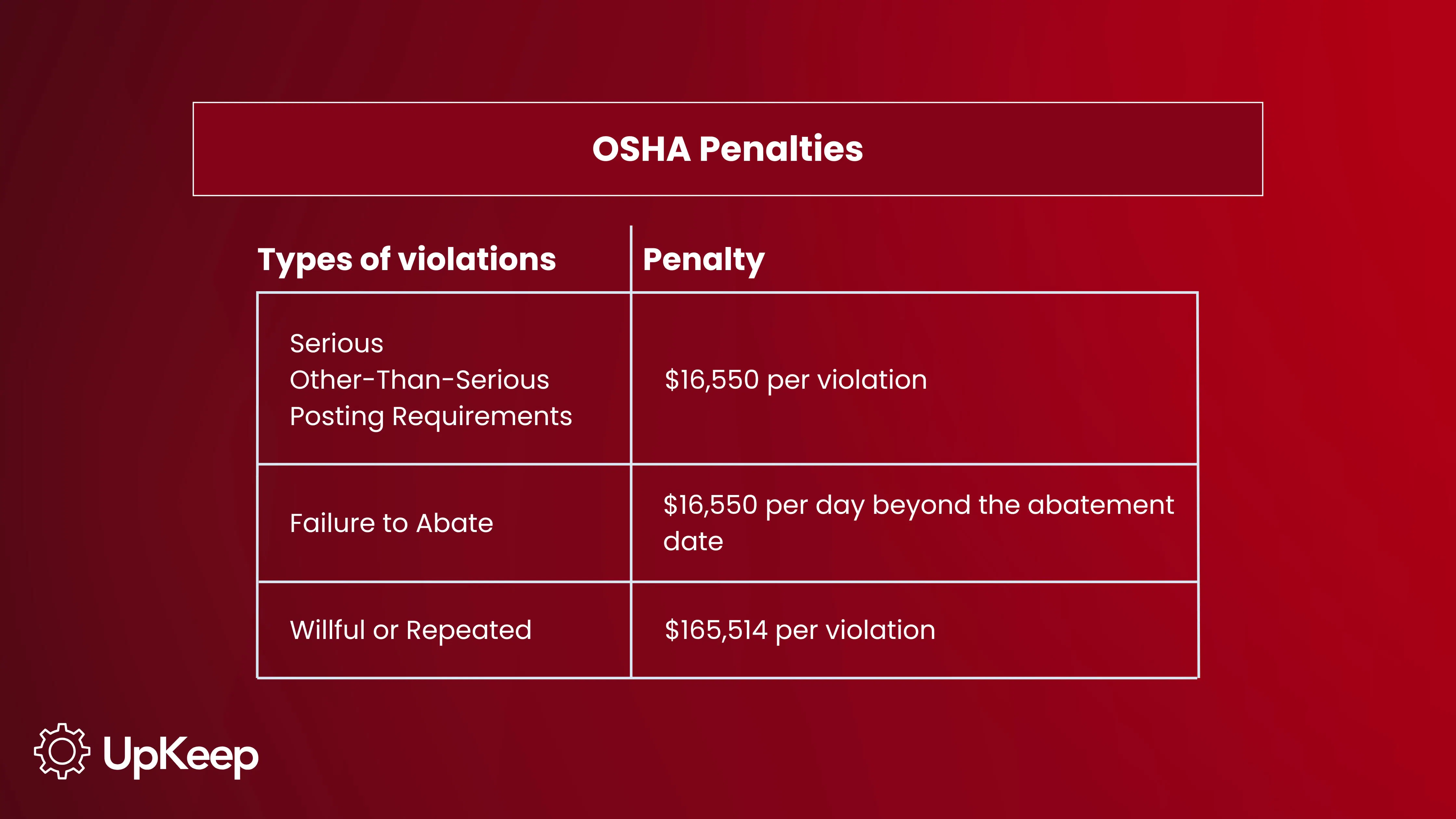
Safety is the baseline of every maintenance operation. OSHA regulations are rigorous, and failure to document safety protocols can lead to severe penalties and, more importantly, worker injury.


How a CMMS Helps:
Incident Reporting: Instead of paper forms that are easily lost, CMMS platforms like UpKeep allow technicians to log safety incidents, near misses, and hazards directly from their mobile devices.
OSHA Logs (300 & 300A): EHS (environment, health, and safety) modules specifically help teams maintain OSHA-compliant logs, including Form 300 (Log of Work-Related Injuries and Illnesses) and Form 300A (Summary of Work-Related Injuries and Illnesses).
Lockout/Tagout (LOTO): You can attach digital LOTO procedures directly to work orders. Technicians must verify safety checks before touching the equipment.
Job Hazard Analysis (JHA): Digital workflows allow you to identify hazards and enforce control measures before work begins, creating a timestamped record of due diligence.
2. FDA 21 CFR Part 11 (Electronic Records)
For industries like pharmaceuticals, food and beverage, and medical device manufacturing, data integrity is paramount. FDA 21 CFR Part 11 establishes the criteria under which electronic records and signatures are considered trustworthy and equivalent to paper records.
How a CMMS Helps:
Digital Audit Trails: A compliant CMMS produces a fixed digital trail. Every time a work order is created, modified, or closed, the system records who did it and when it happened.
Electronic Signatures: Technicians can sign off on work orders digitally. These e-signatures are secure, time-stamped, and legally binding so they satisfy the FDA’s requirement for authenticated records.
Data Security: Role-based permissions enable only authorized personnel to approve critical changes or close sensitive compliance tasks.
3. Various ISO Standards
The International Organization for Standardization (ISO) sets the global benchmark for quality and asset management.
ISO 9001 (Quality Management)
ISO 9001 focuses on consistency and customer satisfaction. In a maintenance context, quality means the equipment operates within specifications so the final product isn’t defective.
How a CMMS Helps:
Standardized Workflows: A CMMS allows you to build standardized checklists for every PM task. Whether it’s Technician A or Technician B doing the job, the steps and quality of work remain the same.
Vendor Management: You can track vendor performance and confirm external contractors meet your internal quality standards before closing their work orders.
ISO 55000 (Asset Management)
ISO 55000 is the gold standard for managing physical assets. It requires organizations to realize value from their assets by balancing cost, risk, and performance.
How a CMMS Helps:
Life Cycle Tracking: This standard focuses on deriving value from assets. A CMMS should track an asset’s entire journey from installation to disposal, giving you the data needed to make strategic decisions.
Strategic Planning: By tracking metrics like mean time between failures (MTBF) and mean time to repair (MTTR), you move from reactive fixing to strategic management, a core tenet of ISO 55000.
ISO 27001 (Information Security)
While this is an information security standard, it’s critical for maintenance teams using cloud-based software to ensure the data stored (i.e., asset locations, proprietary processes, employee info) is secure.
How a CMMS Helps:
Vendor Risk Management: A modern CMMS must be built on an infrastructure that’s ISO 27001 certified.
Data Integrity: The platform uses enterprise-grade encryption and role-based access controls so that sensitive operational data can’t be tampered with or accessed by unauthorized users.
Business Continuity: A cloud-based CMMS backs up your maintenance records so they’re accessible even if your physical site suffers a disaster, supporting the business continuity aspect of ISO 27001.
4. FDA Food Safety Modernization Act (FSMA)
In the food and beverage industry, contamination control is crucial. You must prove the equipment is clean, calibrated, and operating within safe parameters.
How a CMMS Helps:
Sanitation Scheduling: You can automate recurring PMs for cleaning cycles. If a sanitation task is missed, the system flags it immediately to prevent a potential health hazard.
Audit-Ready History: When an inspector asks for sanitization or cleaning history, you can pull up the exact work order in seconds, complete with a photo of the cleaned machine and the technician’s signature.
5. The Joint Commission Regulations (Healthcare)
Hospitals and healthcare facilities in the United States face strict regulatory standards from the Joint Commission regarding patient safety and care environments.
How a CMMS Helps:
PM Compliance Reporting: The Joint Commission often looks for 100% completion rates on critical life-safety equipment inspections (like fire alarms and generators). A CMMS like UpKeep provides dashboards that visualize PM compliance rates in real time so you know you’re audit-ready before the inspector arrives.
Asset History: Maintain a complete log of all repairs on critical medical devices to prove they’re maintained according to manufacturer specifications.
6. Environmental Protection Agency (EPA) Regulations
Facilities often need to track hazardous materials, refrigerant leaks, or emissions to avoid heavy environmental fines from the Environmental Protection Agency.
How a CMMS Helps:
Leak Detection & Repair: IoT sensors can trigger work orders automatically if environmental conditions like temperature or pressure drift out of range.
PM for Emissions: Service scrubbers, filters, and other environmental control equipment on a strict schedule to maintain compliance with discharge permits.
Refrigerant Management: Track and report on refrigerant usage and disposal to meet environmental regulations
7. 21 CFR Part 820
This standard (often referred to as the Quality Management System Regulation) applies to medical device manufacturers. It mandates that equipment used in manufacturing must be routinely calibrated, inspected, and maintained to verify it meets specifications.
How a CMMS Helps:
Calibration Management: The standard explicitly requires calibration for all inspection, measuring, and test equipment. A CMMS schedules these calibration events, tracks the standards used (e.g., NIST-traceable weights), and stores the results directly on the asset record.
Equipment Maintenance: Manufacturers must establish and maintain schedules for the adjustment, cleaning, and other maintenance of equipment. A CMMS automates these PM schedules through checklists so no maintenance task is missed and provides proof of compliance during an inspection.
Document Controls: SOPs and maintenance procedures must be controlled. A CMMS provides technicians with the current, approved version of a checklist or manual attached to the work order.
The Bottom Line
Regulatory bodies demand proof, not promises. A CMMS serves as the single source of truth that organizations need to validate safety protocols and avoid costly penalties. Without a centralized digital system, maintenance teams remain vulnerable to human error and lost documentation during critical audits. Adopting this technology ensures every asset, inspection, and repair is accounted for automatically.
Frequently Asked Questions
How does a CMMS prepare you for compliance audits?
A CMMS centralizes all maintenance activities and asset histories into a single, searchable database. This consolidation allows teams to generate reports instantly that prove 100% PM compliance and show a complete audit trail for every asset. Instead of scrambling to find missing paperwork, managers can present auditors with irrefutable, time-stamped evidence of due diligence.
Can a CMMS replace paper compliance records?
Yes, digital systems provide a more secure and verifiable alternative to paper logs. CMMS platforms create audit-proof digital records that automatically capture user IDs and timestamps, making them far more reliable than paper forms that can be lost, damaged, or illegible. Digital tools also enrich these records with photo verification and electronic signatures, which offer a higher standard of proof for regulatory bodies.
How long should compliance records be kept in a CMMS?
Maintenance records should generally be retained for the entire life of the equipment, from installation to decommissioning. Cloud-based CMMS platforms store this historical data indefinitely, allowing organizations to access maintenance logs, safety reports, and repair histories years after the work ends. Preserving this long-term data is essential for analyzing asset performance trends and defending against liability claims regarding past maintenance.
Does mobile CMMS access improve compliance?
Mobile access significantly improves compliance by enabling technicians to document inspections in real time at the point of service. Technicians can scan QR codes and upload photos directly from the field for accurate data capture, rather than relying on memory at the end of a shift. This capability eliminates data entry lags and verifies all safety checks with precise, on-site evidence.
4,000+ COMPANIES RELY ON ASSET OPERATIONS MANAGEMENT
Leading the Way to a Better Future for Maintenance and Reliability
Your asset and equipment data doesn't belong in a silo. UpKeep makes it simple to see where everything stands, all in one place. That means less guesswork and more time to focus on what matters.






![[Review Badge] Gartner Peer Insights (Dark)](https://www.datocms-assets.com/38028/1673900494-gartner-logo-dark.png?auto=compress&fm=webp&w=336)