How IoT Predictive Maintenance Helps Teams Work Less and Accomplish More
Key Takeaways
-
IoT predictive maintenance replaces costly reactive repairs with data-driven intelligence, turning sensor readings into automated work orders before failures occur.
-
Organizations that connect asset data across a unified platform see measurable gains in uptime, safety, and operational ROI.
-
The transition to IoT predictive maintenance starts with a single critical asset, the right platform, and a clear baseline before scaling.
For most maintenance teams, the workday is defined by reaction. A machine goes down, someone files a work order, another person sources parts, and the entire team loses hours or days of productivity. The cycle repeats. This is the world of reactive maintenance, and for organizations that depend on operational uptime, it's one of the most insidiously expensive habits they keep.
IoT-based predictive maintenance (PdM) breaks that cycle. By embedding smart sensors across equipment and connecting that data to AI-driven analytics platforms, teams gain something they've never had before: the ability to see failure coming and act before it arrives. The result is a fundamentally smarter, more efficient way to operate.
What Is IoT-based Predictive Maintenance?
Traditional preventive maintenance operates on a schedule, such as changing oil every 3,000 miles, inspecting motors every quarter, or replacing belts annually. The logic seems sound, but the reality is, less than 20% of assets fail based on age. That means the majority of time-based maintenance tasks may be consuming labor and parts budgets without delivering meaningful protection.
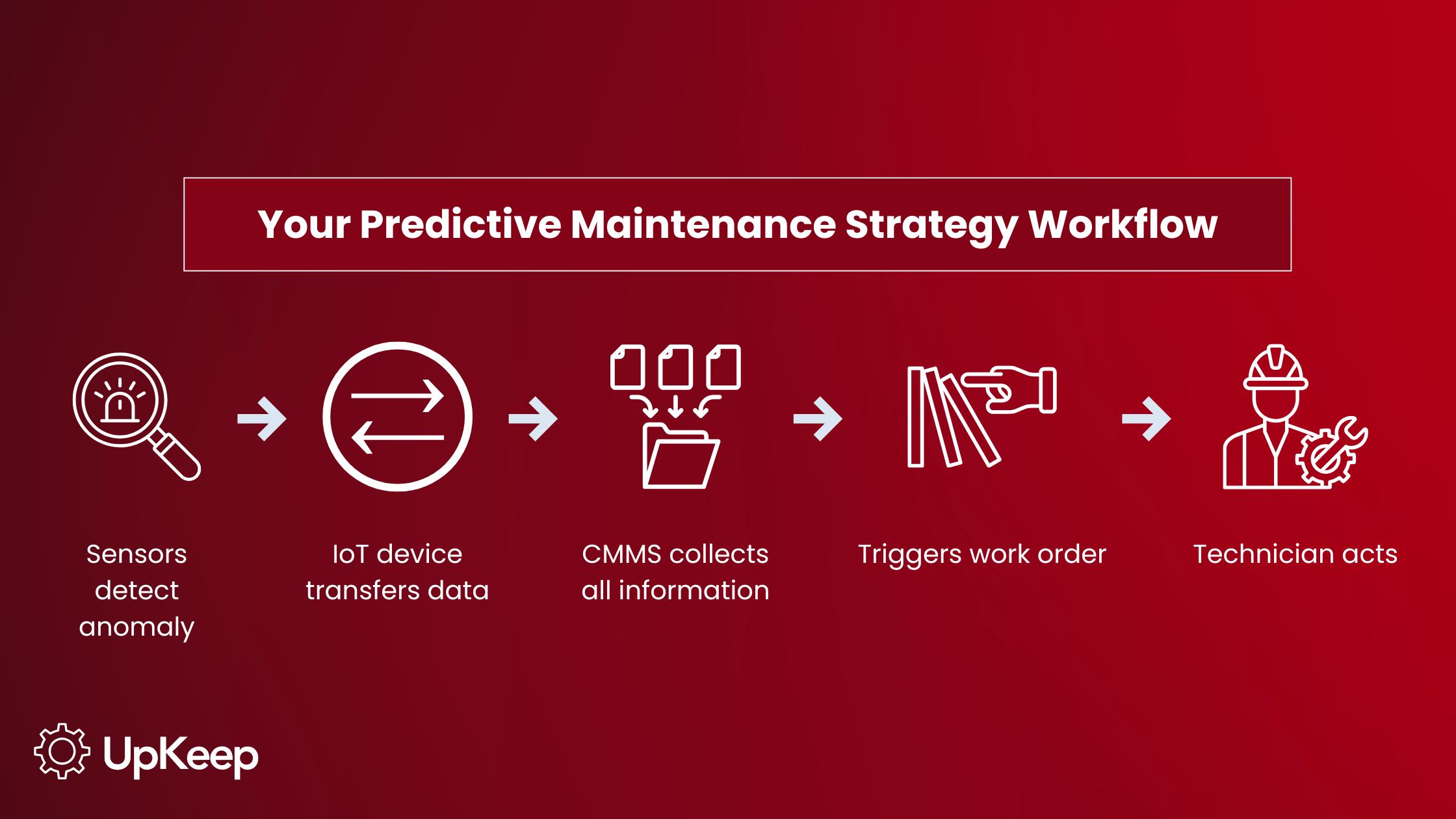
IoT predictive maintenance replaces that guesswork with real evidence. Vibration sensors, ultrasound detectors, infrared monitors, and oil analysis tools continuously stream data about how equipment is actually performing. When readings drift outside acceptable parameters, the system flags the issue and, on a connected platform, can automatically generate a work order before a technician even knows there's a problem.
This is the shift from reactive to intelligent, turning asset data into operational decisions in real time.
3 Advantages of Using IoT for Predictive Maintenance
1. Lower Operational Costs and Increase ROI
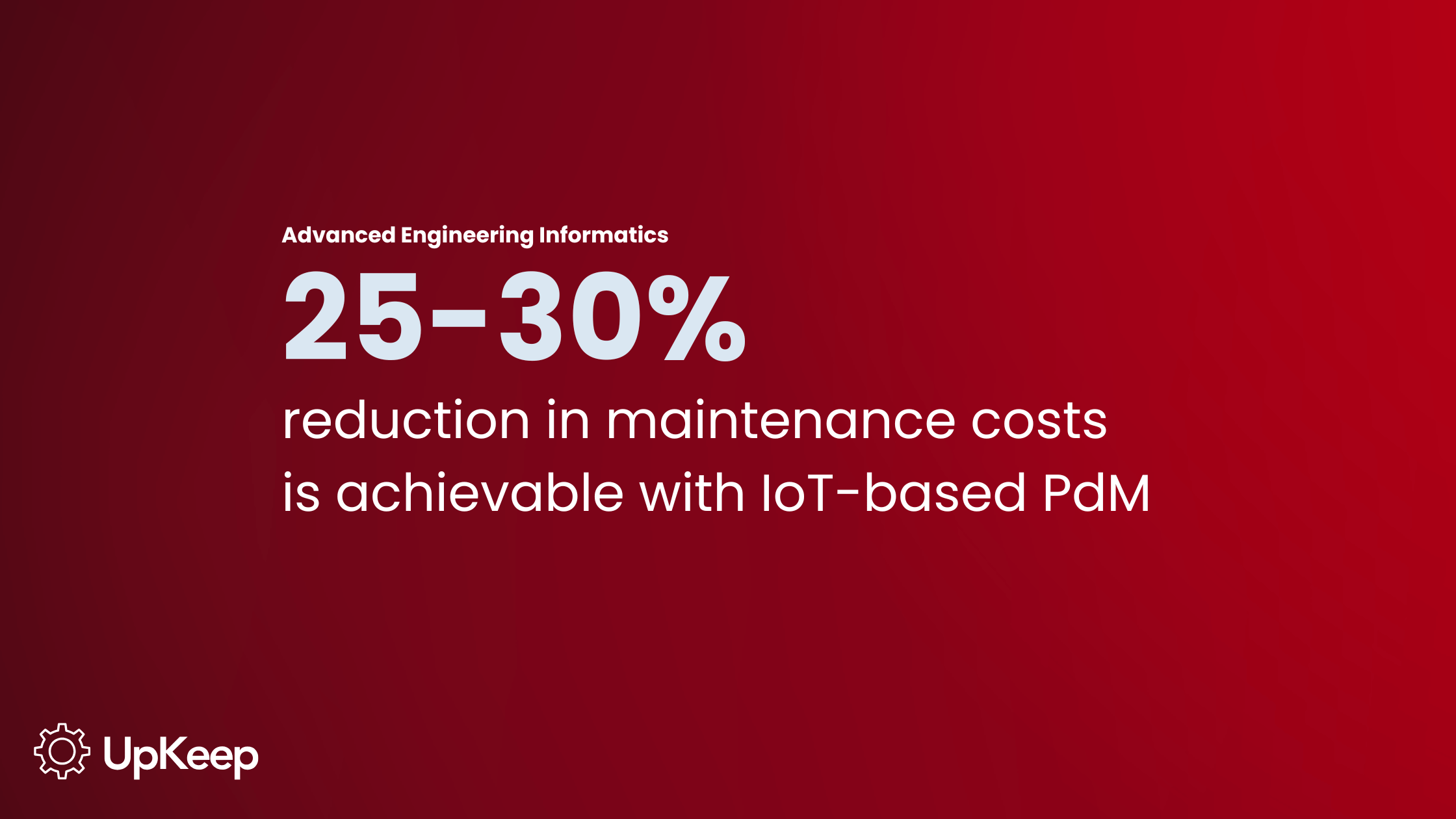
One of the most compelling arguments for IoT predictive maintenance is what it does to the bottom line. Real-world deployments have demonstrated maintenance cost reductions of 25%–30% and returns on investment of up to 10 times within a year.
2. Maximize Equipment Performance and Minimize Downtime
Continuous sensor monitoring captures temperature, vibration, humidity, and other parameters that reveal how quickly equipment is degrading, giving teams the visibility to keep critical assets running reliably. When connected to a condition-based monitoring (CBM) system, the platform automatically generates a work order the moment readings drift outside acceptable parameters. Documented industrial implementations have shown this approach reduces equipment breakdowns by 70%–75% and cuts downtime by 35%–45%.
3. Improved Safety and Compliance in Operations
IoT sensors identify potential workplace hazards in real time and alert workers to dangers before incidents occur. With unified maintenance, safety, and reliability data on a single platform, operations leaders gain the visibility needed to stay ahead of compliance requirements, avoid accidents, and reduce exposure to fines and reputational risk.
3 Common Challenges When Implementing IoT Predictive Maintenance
1. Data Privacy and Security Concerns
Predictive maintenance generates massive volumes of real-time streaming data across thousands of IoT sources, and protecting that data demands a strong infrastructure. As sensor networks expand across facilities and geographies, organizations need enterprise-class privacy, access controls, and compliance-ready data governance built into the platform.
2. Integration With Existing Systems and Technologies
Many industrial environments still operate with expensive, rigid legacy monitoring systems that are difficult to scale and can’t adapt to rapidly changing operational needs, making integration with modern IoT platforms a central implementation challenge.
Configuring predictive maintenance solutions correctly requires engineers, infrastructure architects, and data scientists to align sensors, data types, and analytical methods. This can be difficult for smaller organizations with fewer resources.
A connected platform approach unifying CMMS, EAM, EHS, and edge data creates a single source of truth rather than layering new tools onto siloed systems.
3. Skills Gap in Workforce for IoT Management
Deploying and interpreting IoT sensor data demands new competencies in data analysis, machine learning, and system configuration that many existing maintenance teams haven’t yet developed. Key challenges in predictive maintenance adoption include data gaps, low organizational adoption rates, and difficulty measuring ROI, which impedes scaling.
Bridging this gap requires investment in training, intuitive tooling, and AI-native interfaces that reduce the learning curve for frontline technicians and operations managers alike.
Clearing the Barriers to IoT Predictive Maintenance
The Challenge |
What the Right Platform Solves |
|
Data privacy and security |
Built-in enterprise-class privacy controls, access management, and compliance-ready data governance |
|
Legacy system integration |
A unified platform combining CMMS, EAM, EHS, and edge data for a single source of truth |
|
Workforce skills gap |
AI-native interfaces and intuitive tooling to reduce learning curves |
How Technology Empowers IoT Predictive Maintenance Solutions
A vibration sensor that logs readings into a standalone system is disconnected from the work order platform, the inventory, and the fleet data. It’s information without action.
The power of IoT predictive maintenance comes from connection: sensor data flowing into a CMMS like UpKeep’s, automatically triggering work orders and surfacing asset health insights across departments. That’s why platform integration is a critical evaluation criteria when choosing a predictive maintenance solution.
For multi-site operators and enterprise leaders, this connectivity also means visibility at scale. Comparing asset health across facilities, benchmarking technician productivity, and identifying systemic patterns across an equipment portfolio all become possible when the data is centralized and consistent.
How to Strategize Your Transition to IoT Predictive Maintenance
Step 1: Assess Current Maintenance Practices
Begin by auditing existing PM schedules to identify which assets are being over-maintained on time-based cycles versus which are genuinely failure prone. Then, establish baseline metrics for downtime, maintenance costs, and technician hours so that ROI from a predictive program can be measured concretely over time.
Step 2: Choose the Right IoT Solutions and Vendors
Prioritize platforms that offer unified asset data across CMMS, EAM, and edge monitoring, avoiding point solutions that create new silos rather than eliminating existing ones.
To evaluate vendors, focus on configurability, integration breadth, enterprise-grade security, and the quality of their analytics, ensuring the solution can scale with operational complexity.
Step 3: Develop a Roadmap for Implementation
Building a fully fledged predictive maintenance program can be done incrementally. Start with a single critical asset. Install sensors, begin tracking data, set maintenance trigger parameters, and adjust your approach as needed before scaling to the next asset.
IoT Predictive Maintenance in Practice
IoT predictive maintenance can look slightly different depending on the industry. Here are some data-driven, real-world examples demonstrating its impact.
Manufacturing
Almost 40% of all machinery breakdowns are due to bearing failures, according to research from the American Society of Mechanical Engineers (ASME). Vibration sensors detect these developing faults early, giving teams a reliable window to schedule repairs before a breakdown occurs.
Smart factories
IoT enables real-time monitoring of energy consumption, supply chain tracking, and inventory optimization alongside predictive maintenance, delivering comprehensive operational intelligence. Research on IoT-integrated inventory systems found average improvements of 25-35% in inventory accuracy, a 20%-30% decrease in carrying costs, and 35%-45% fewer stockout incidents.
Fleet operations
Operators can deploy onboard IoT diagnostics to predict component failures across vehicle fleets, scheduling repairs during off-hours rather than losing vehicles mid-route. An analysis of predictive maintenance in logistics fleets found that IoT and AI-driven programs cut fleet downtime by 50%, maintenance costs by 40%, and equipment failure rates by 60%.
Embracing IoT for a Robust Maintenance Strategy
The AI-driven analytics, edge computing, and connected platforms that enable IoT predictive maintenance are only becoming more capable and more accessible. Organizations that invest now are building a compounding advantage of better data, better models, and better decisions year after year. Without it, organizations will continue to face the costs of emergency repairs, unplanned downtime, and underutilized technicians.
Start with one sensor. Connect it to the right platform, then let the data tell you what to do next. That’s where the shift from reactive to predictive begins, and the operational gains will follow.
FAQ: Your IoT and Predictive Maintenance Questions Answered
What types of IoT sensors are used in predictive maintenance?
The most common include vibration sensors, temperature sensors, ultrasound sensors, infrared sensors, and oil analysis sensors. Each targets specific failure signals; vibration sensors detect bearing wear and misalignment, while thermal sensors flag overheating components before they fail, for example.
How does IoT data get turned into a maintenance action?
Sensor data streams continuously into an analytics platform where AI algorithms compare readings against established baselines. When a reading drifts outside acceptable parameters, the system automatically generates a work order. This turns the intelligence into action without manual intervention.
How long does it take to implement predictive maintenance with IoT?
A single-asset pilot can become operational within weeks. However, scaling across a full facility typically takes several months to a year depending on the complexity of your equipment and infrastructure. Most organizations begin seeing measurable ROI within the first year.
Want to keep reading?
The 6 Sensors for Predictive Maintenance That Optimize Repair Timelines
What's the association between IoT and predictive maintenance?
How are sensors used in predictive maintenance?
4,000+ COMPANIES RELY ON ASSET OPERATIONS MANAGEMENT
Leading the Way to a Better Future for Maintenance and Reliability
Your asset and equipment data doesn't belong in a silo. UpKeep makes it simple to see where everything stands, all in one place. That means less guesswork and more time to focus on what matters.






![[Review Badge] Gartner Peer Insights (Dark)](https://www.datocms-assets.com/38028/1673900494-gartner-logo-dark.png?auto=compress&fm=webp&w=336)