Entrada en el Blog
Un regreso a lo real: el estado actual del mercado laboral de EE. UU. en 2023
La necesidad de industrias del mundo construido, relaciones en persona e independencia doméstica.


Over the past several months, we’ve seen nearly daily headlines about layoffs at some of our country’s largest corporations. Tech jobs, in particular, seem to be vanishing at an astonishing rate, especially after years of digital acceleration fueled by the global pandemic. While white-collar layoffs, particularly in tech, are nearly double what they were two years ago, construction, transportation, warehousing, and manufacturing added 67,000 jobs in January alone. What is going on?
While economists, political pundits, and journalists draw their own conclusions, I believe we are struggling to find the right balance between the digital and the real. Rapid innovation in the digital world fights for the employees of tomorrow with those businesses producing material goods in our physical world. Professionals weigh the freedom and flexibility of remote work against the isolation that often results, and manufacturers consider the potential cost savings of offshore sourcing against the risk of supply chain disruptions.
The Digital vs. the Built World
While technology and digitalization have been ramping up for decades, the circumstances surrounding the COVID pandemic accelerated its adoption in unprecedented ways. Very quickly, the majority of the population learned to use video conferencing and remote project management solutions as our schools and businesses shuttered their doors. According to statistics sourced from Finances Online, roughly 30 percent of global companies started using video conferencing for the first time during COVID-19.
At the same time, the development of new apps, software, platforms, tools and online resources exploded. According to a McKinsey global survey of executives, “companies have accelerated the digitization of their customer and supply-chain interactions and of their internal operations by three to four years. And the share of digital or digitally enabled products in their portfolios has accelerated by a shocking seven years.”
I believe the tech world expected this pace to continue post-pandemic. In fact, the largest five tech companies nearly doubled the number of tech workers they hired between 2019 and 2022. Now, this over-hiring is resulting in significant white collar layoffs as the economy slows down.
Meanwhile, the manufacturing, construction, hospitality and other in-person industries had a very different experience. These traditionally blue-collar sectors had no option to perform many of their daily tasks remotely. Instead, factories and businesses simply closed their doors–sometimes temporarily, often permanently. While federal aid helped some businesses weather and survive the pandemic, roughly 200,000 additional businesses closed for good as a result of COVID-19. In addition, the U.S. Bureau of Labor Statistics reported that “manufacturing output fell at a 43-percent annual rate and hours worked fell at a 38-percent rate in the second quarter of 2020. These were the largest declines since World War II.”
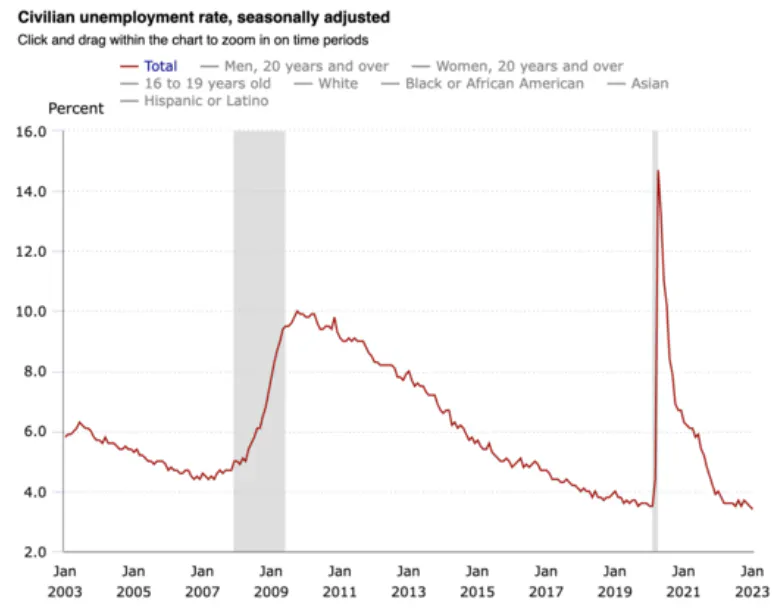
This situation resulted in a shift away from jobs in the built-world as retail shops closed and many employees either left the labor force or transitioned from in-person to remote work to avoid COVID exposure. While the unemployment rate reached an all-time high of 14.7 percent in April 2020, it dropped to 3.5 percent by July 2022, equal to the lowest it has been in 50 years. Now, we have even a greater skills gap and labor shortage in the built world.
We need to regain that balance between employees trained in developing the digital technologies of tomorrow against those who are skilled to produce the physical products we all use today.
Remote vs. In-Person
Similar to the trajectory of digitization, the idea of working from home existed before the pandemic but was not at all widespread. Even the majority of white-collar professionals still commuted to an office, had in-person meetings, and worked a nine-to-five schedule. COVID changed that status quo due to necessity. In fact, according to the U.S. Bureau of Labor Statistics, more than one-third of all employed people worked remotely in May 2020 due to the global pandemic.
As COVID went on, businesses realized that, in many cases, remote teams offered many advantages. They were often just as productive, delivered the work-life balance many employees desired or needed, and eliminated the cost of maintaining a physical office. Many established professionals preferred this arrangement, and flexible, remote options quickly became a valuable bargaining chip during the labor shortage.
When the risks of the pandemic began to subside, businesses were left pondering the work arrangements of the future. Some returned completely to the office, others stayed remote-only and many offered hybrid arrangements. Younger employees, in particular, craved in-person work arrangements, seeking to build real relationships with colleagues and mentors and avoiding the isolation that often came with remote work. In fact, Harvard Business Review reported that about 85 percent of employees would be motivated to go into the office to rebuild team bonds, socialize with coworkers and reconnect with work friends.
Blue-collar positions have traditionally appealed to individuals who prefer to work in the built world – operating equipment, constructing things with their hands, or assisting customers in a physical environment. I think it’s important to remember that many interesting, challenging opportunities still exist in the real world, despite the fascination with the virtual one.
Global vs. Domestic
As the world has gotten “smaller” with globalization and international trade, it has also become less personal. Gone are the days when you knew who produced your food, fixed your farming equipment, or made your clothing. After World War II, American consumerism went into full swing, demanding more and newer products than ever before. Manufacturers of consumer goods ramped up production and looked for less expensive raw materials and production processes to keep prices low and volumes high.
Over time, many U.S.-based companies were not only purchasing cheaper raw materials from abroad but physically moving manufacturing overseas to reduce costs. In some cases, globalization also opened the door to a greater number of competing suppliers. According to the Regional Economist, “manufacturing employment in the U.S. economy peaked in 1979 at almost 20 million workers. In subsequent years, the U.S. economy shed manufacturing jobs, reaching a low in 2010 of 11.5 million workers after the Great Recession.”
Yet, when the pandemic struck and the world came to a halt, demand for manufactured goods skyrocketed and a myriad of supply chain disruptions revealed the weaknesses of depending on this global system. Both governments and businesses began rethinking the wisdom of relying on foreign suppliers and manufacturing locations.
Although both the government and the business world are trying to bring more manufacturing back to the country with reshoring efforts, significant challenges remain. According to a recent Deloitte study, US manufacturing is expected to have 2.1 million unfilled jobs by 2030. “The lack of skilled labor was the industry’s major challenge even before the pandemic … and is still a major concern today,” reported the National Association of Manufacturers.
Conclusion
When surveys find that 90 percent of employees are just as or more productive in a remote setting and nearly that many believe that working remotely would make them happier, how do we attract top talent to those positions that require a physical presence? What can we do to make those jobs more attractive? I don't know exactly what the answer is yet, but I do know that supporting our built world is critically important for our country’s future stability and long-term success.
Follow me and read more of my articles and blogs!
¿Quieres seguir leyendo?



Artículo
$ 1,2 billones: el costo del mantenimiento diferido para los EE. UU.


Artículo
Lo que podemos aprender del colapso de la cadena de suministro 3 años después en 2023


Artículo
Es hora de subir de nivel el rol de mantenimiento
MÁS DE 4000 EMPRESAS CONFÍAN EN LA GESTIÓN DE OPERACIONES DE ACTIVOS
Liderando el camino hacia un futuro mejor para el mantenimiento y la confiabilidad
Los datos de sus activos y equipos no pertenecen a un silo. UpKeep simplifica ver dónde se encuentra todo, todo en un solo lugar. Eso significa menos conjeturas y más tiempo para concentrarse en lo que importa.






![[Review Badge] Gartner Peer Insights (Dark)](https://www.datocms-assets.com/38028/1673900494-gartner-logo-dark.png?auto=compress&fm=webp&w=336)