Entrada en el Blog
S2:E26 Mantenimiento y optimización de la confiabilidad con Nathan Kelley
¡En este episodio de MIM, estamos emocionados de tener a Nathan Kelley, supervisor de ingeniería de confiabilidad, optimización y CMMS en Chevron, en el programa!


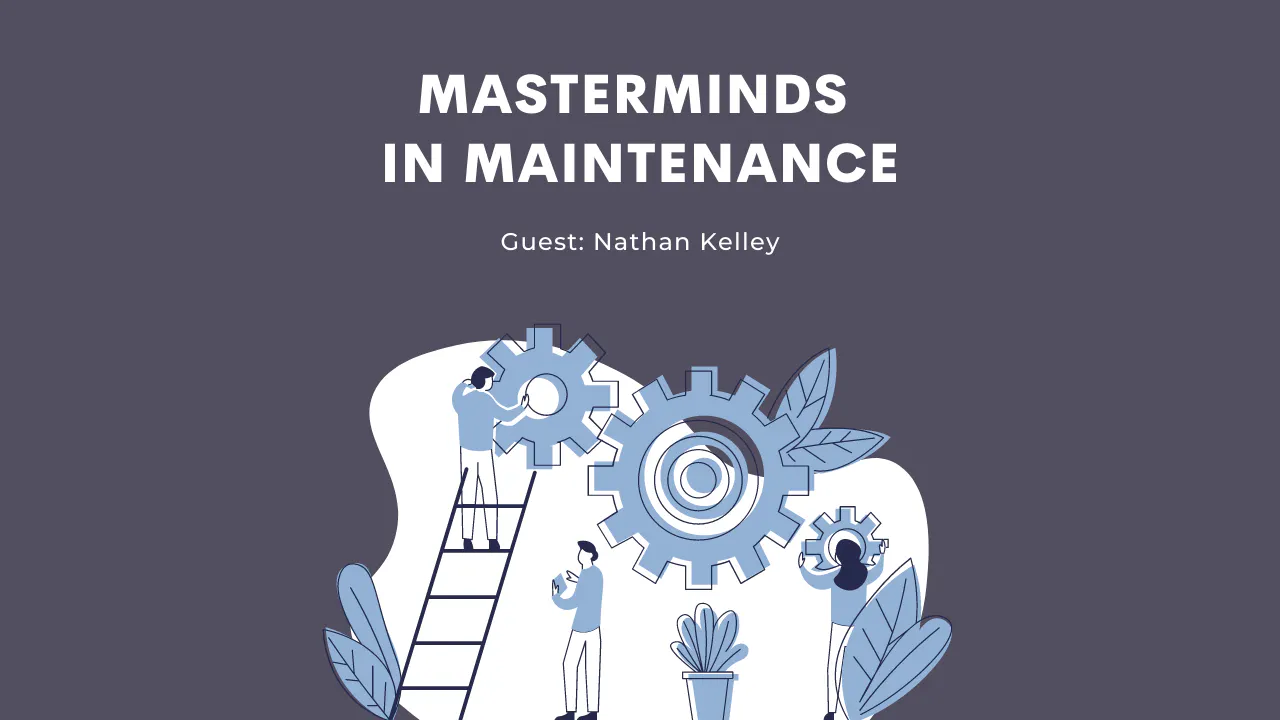
Nathan Kelley is a Reliability Engineering, Optimization, and CMMS Supervisor at Chevron!
Summary
In this week's episode of Masterminds in Maintenance, we are excited to have Nathan Kelley, Reliability Engineering, Optimization, and CMMS Supervisor at Chevron, on the show! Nathan has tons of experience and knowledge in optimization, and Ryan takes the opportunity to learn more from him about this topic! Take a listen today!
[Embedded content: https://anchor.fm/upkeep/embed/episodes/S2E26-Maintenance-and-Reliability-Optimization-with-Nathan-Kelley-epgm7g]
Episode Show Notes
Podcast Platforms
Transcript
0:00:04.5 Ryan: Welcome to Masterminds in Maintenance, a podcast about those with new ideas in maintenance. I'm your host, Ryan, I'm the CEO and Founder of UpKeep. Each week, I'll be meeting with a guest who's had an idea for how to shake things up in the maintenance and reliability industry. Sometimes the idea failed, sometimes it made their business more successful, and other times their idea revolutionized an entire industry. Today, I'm super excited, we've got Nathan Kelley here on the show. Nathan is a reliability engineer, optimization and CMMS supervisor over at Chevron. Welcome to the show, Nathan. I'm really excited to have you.
0:00:35.7 Nathan Kelley: Thanks, Ryan, I'm glad to be here. Thank you for the invitation. I think this is gonna be a fun time. So thanks for having me on the show.
0:00:42.0 Ryan: The way that we always kick things off is having you share a little bit more about your background and how you were introduced into this field of maintenance and reliability.
0:00:50.6 NK: I started off as a chemical engineer and my first job was in material and process engineering at The Boeing Company. I started using design of experiments to increase production yields and really getting into statistics, picked up my black belt in Six Sigma. And while I was there, I started working on an industrial engineering degree at night and switched over to supplier quality engineering and was working supplier quality issues in the supply chain for the 787. After about eight years at Boeing, this job came up with Chevron out in Western Colorado for a reliability engineer, and it just spoke to me on a lot of levels. It was using a lot of the statistical knowledge that I had picked up, it was building on my Industrial Engineering degree, but a little bit different twist than the quality engineering I was used to, so enough of a challenge there to make the jump. So I jumped into Chevron about seven years ago, and have been working in reliability and maintenance ever since.
0:01:52.1 Ryan: To kick things off, you and I share a similar background in ChemE. You spent the first couple of years of your workforce as a ChemE and then you made the transition over into maintenance and reliability. I'm curious, from your eyes and ears, what was that transition like? Moving from process engineering, the ChemE side, over into maintenance and reliability? What was the same and what was different?
0:02:16.3 NK: There was probably more similarities than I would have expected. Working in process engineering, you're really focused on optimization and getting your production yields up, and maintenance and reliability is still working on optimization as well, it's just in a little different space, you're just focused on the maintenance and reliability side of it. But working in this space, you meet people that have got here in a lot of roundabout ways, and a lot of M&R teams are very diverse, and you can have some really good problem-solving groups and teams with that kind of diversity. So it's a great place to be, a great place to work, and a great career for those that are interested in it.
0:03:00.1 Ryan: Yeah, I love it. And obviously, you've dedicated your career since then, into this industry, you haven't left it. So it sounds like it's something that you love, Nate. You mentioned something around optimization. Obviously, it's a core component to both process engineering and also reliability, so I'd love to like dig in and open up this topic a little bit more. How exactly do you define maintenance and reliability optimization? Why is it important? And yeah, I'd be curious about some of the things you've learned along the way, when you focus so much on this core problem around optimization.
0:03:36.4 NK: When I'm thinking about maintenance optimization, I'm thinking about minimizing the total cost of ownership or the life cycle cost of the asset. Reliability does have interplay with maintenance. Sometimes people think they're connected, but there is some connection there and there is some disconnect, because reliability, you usually have to pay for. You pay for that upfront in design, you pay for it in redundancy, you pay for it in the rigor of your maintenance plans. In order to know how you should execute your maintenance in the cheapest way possible, you really have to understand the criticality of your asset. I've seen lots of creative ways that different companies assign criticalities to their assets, but it's usually on some sort of high, medium or low system. But understanding the criticalities of your assets helps you to know what reliability you're shooting for or targeting, and then you adjust your maintenance program around that. So you're trying to balance two different drivers when you're optimizing maintenance. You wanna lower the cost, while also achieving that reliability target, and sometimes they can be in contradiction. So it takes some creative ways to get there, but in a nutshell, that's what you're trying to do.
0:04:57.4 Ryan: The highest risk, most critical, coupled with the lowest cost, and that's kind of how you prioritize what you do, and ultimately, like you mentioned, optimize both cost savings and also reliability up top. So I guess the question to you, Nate, is do you have any tips, recommendations to our listeners on how to make that trade-off, and also how to get the team behind you and how to get leadership bought into these trade-offs?
0:05:30.2 NK: A common tool that I use, it's RCM, reliability center maintenance, it's a structured approach on how to go about making those trade-offs. There's a lot of books on it. One is written by John Moubray, it's called RCM II, very foundational for listeners that are new to the space. But just some key things out there, when you're looking at optimizing a maintenance program, you wanna make sure that the right skill level is working the task. If a mechanic is doing something that an operator could do or has the capability to do, you should give it to the operator because that labor is cheaper than having the mechanic view it. The next one I like to look at is avoiding intrusive tasks. There's always a lot of risk when you go in and open a piece of equipment, it gets messy, sometimes you make mistakes, things might not always go back together correctly. If you went to the hospital and you went into surgery once a quarter, how would your body hold up to that? After a while, your body would start to break down. You wouldn't be the same person anymore. Machines are very similar to that.
0:06:37.6 NK: You're going in there, opening them up, it's gonna hurt them, and so trying to avoid those intrusive tasks as much as possible, they're kind of your last resort. And if there's things that you're looking for, trying to find things that you can monitor the those through condition monitoring or predictive maintenance techniques or instrumentation. Number three is PM, findings is a very good one. So oftentimes, we're going out, we're executing PMs, but if we're not getting a lot of findings on those PMs, how useful are they really? And there's a common rule in the M&R space, the six to one ratio. Usually a good PM, you should be getting one finding for every six of those tasks. If you've done 7 PMs and you've had no findings on that particular task, that's an opportunity to extend the frequency of that or possibly eliminate it.
0:07:31.6 NK: And then I think another big thing is eliminating subjectivity in those maintenance task plans too. You tell a mechanic to go and check the oil and make sure it's good. What is good? You ask 10 mechanics what good is, they may all give you a different answer, but you gotta be very specific on what good is. Is it the oil is between 75% to 100% of the gauge? Is that good? Is it the oil is not cloudy? Is that good? Those are four common things I look for, but those are all RCM methods, and part of that RCM process.
0:08:04.4 Ryan: I feel like oftentimes when I talk to people in the industry, it's always about net new, it's always about, we need one more, we need one more PM, we need one more back-up for X, Y or Z. But oftentimes I feel like the discussion isn't around, well, what are we currently doing and how do we take what we're currently doing and make it even better? And I feel like that's what you mean around optimization, especially with regards... I think that one of the best examples you brought up is this 1-6 ratio. If you're running PMs and you don't find anything, why do you have it? Maybe the question for me to Nate is, what are some of the biggest, most common pitfalls that you see with companies or with groups and organizations, with regards to optimization, or let's call it the lack of?
0:08:55.5 NK: People tend to over-simplify maintenance and reliability, and usually they just start off doing the OE recommendations. I'm not saying that's necessarily a bad thing, but it's not the final point where you wanna be. A lot of the times, those OEMs have their own hidden values that they're trying to do too. They wanna open up new revenue streams with part sales and things like that, so they tend to be very conservative, make you spend more money than you would normally do. People that are just getting new into the RCM space and they start trying these RCM methods and going beyond the OEM recommendations and really trying to cost-optimize what they're doing, they'll find millions of dollars of uncaptured value going into that space.
0:09:37.8 NK: One of the things I recommend is when you're just starting to get your feet wet in the space, go out and find the asset that's your biggest problem that's causing you headaches, that's making you stay up at night, go do that one first, start with the OEM recommendations, do that for a little bit, but then do RCM on it, do an RCM study and optimize the maintenance plans and the maintenance tasks, and then compare the difference between the two. You'll see savings in labor, you'll see savings in costs, you'll see improvement in performance, and that can be the fuel to help you scale up your program across your company or your organization, just starting with one win at a time.
0:10:23.5 Ryan: No one gets fired by following OEM manufacturing recommendations around PMs, so going off and finding your own, you have to have a lot of confidence in that and confidence in your own RCM study. So maybe the question there is, where do you go to learn and find that confidence in making recommendations that actually might go against the traditional OEM guidelines?
0:10:52.0 NK: A lot of that confidence comes from data. Data can help free you from those OEM recommendations. If you're doing those OEM recommendations and you're not getting a lot of PM findings on it, that you're seeing through your CMMS system, that's a good flag to you to just back off on those. Their first reaction is if this thing's breaking, I need to do more maintenance and more and more maintenance, and then it breaks more and more and more, and sometimes they don't always understand the underlying failure modes of the components in that asset. If it's a wear-out failure, a schedule-based intrusive PM might be good for that to go in and replace the component. But if it's a random failure or an infant failure, and you're going in there and intrusively inspecting whatever that component is every time, you're making the situation worse. So you're spending more money and getting worse performance. And so it's understanding what those underlying drivers are and using data to help you make those decisions.
0:11:50.0 Ryan: I'd be curious, Nate, how do you utilize your CMMS to uncover all of these findings? And what's the right cadence for someone within a business to be looking at results and analyzing the data to draw conclusions and recommendations?
0:12:07.9 NK: It is debatable, but we're trying to find that right frequency of how often to do it. The data that's going into your CMMS, people need to have access to it, it needs to be transparent, and people need to be seeing the data that they're putting in, people are looking at it and people are making decisions on it, and they're making decisions to improve their everyday work life, making it better, making the equipment run better. Usually, one of the biggest issues I see with the CMMS is the people that are entering the data into the CMMS don't understand where it's going or what it's used for, and that sometimes that can lead to a lack of engagement and maybe they stop putting in as much data as they should, and it kinda just spirals downward. So you gotta keep that data visible and the people inputting the data have to know that you're using it to improve the maintenance and reliability program.
0:13:10.6 NK: Some of these CMMS systems have built-in reporting systems that can definitely help with that, but there's a lot of business intelligence software out there that can help you put together reports pretty quickly too. Power BI, Spotfire, Tableau. Oftentimes people connect these to the back end of their databases, and then they don't take a long time to learn, and then they can start building reports pretty quick and putting them up on the Cloud where everybody can access them, and then start looking at them on a frequent basis. So our reliability team looks at it at least weekly, and we have monthly meetings with our production teams going through the data, and our maintenance teams look at them weekly, but it's out there on the Cloud where people can go and look at them whenever they want.
0:13:51.6 Ryan: The second thing that you mentioned was it's not just a technology challenge, it's also a business/people/process challenge to get people to include the data and make sure that there's adoption with your CMMS. I'm curious, are there things that you've done with your team to really push, encourage, high quality data going into a CMMS?
0:14:14.4 NK: Yeah, one of those big things is reducing the barrier of entry for your users, so making the interface easy and simple to use. So I know a lot of the times in the past, work orders and stuff would go out on paper, people would fill out the work order on paper, and then they'd go back to their office and type it into their computer, into the CMMS. And there's all kinds of forms of waste there. There's the waste of the material itself, there's the waste of the time of writing it on paper and then typing it into the computer, that's almost like double work. The people that are going out and doing the work, they're mobile, and the CMMS really needs to be on mobile devices where they can input the data anywhere, any time immediately after the job, so it's all fresh in their memory on what they did. So we've built some simple mobile solutions to help the data go into our CMMS with mobile devices. There's other things you can do too, like the hierarchy in your CMMS, people have to know that structure, it has to be a structure that's familiar to the operations and the mechanics, know where to go and write the work order to the right level, so whatever the failure data is or the PM data is, it's going to the right asset, so that your reliability engineering team can take action on that data.
0:15:35.8 Ryan: We've also heard, I've spoken to a few companies and leaders before, and they've had tremendous success doing small things too, like buying someone lunch for the person who submits the most requests and having a dinner for the group that completes the most work orders and logs all their time. Even the simplest things actually spur a lot of adoption, and we've seen that across a lot of our customers and people that we've spoken to you in the industry. So, Nate, I really appreciate you jumping on to the show. As we wrap up here, what's one thing you wish more people knew about within the maintenance and reliability space?
0:16:18.1 NK: One of the things I wish more people knew was just how broad and deep the maintenance and reliability space is. Most people have a general understanding of maintenance, most of us own cars, most of us go to the mechanic once in a while to get our cars worked on. Most of us think that maintenance is pretty simple, we just follow those OEM recommendations and do what we're supposed to do and we're good to go, but there's a lot to it. There's the CMMS system, there's planners, there's schedulers, there's this craftsmanship of the mechanics and the electricians. So it's a very broad and deep field, and usually I've met people that have been in the field, they'll specialize in one or two of those things and then generalizing the rest. That's kind of my biggest frustration, is people don't really understand how broad and deep it is, but once you get in there, you really appreciate the depth of the field.
0:17:11.1 Ryan: Nate, as we wrap up here, how can all of our listeners follow you on your journey? How can they connect with you?
0:17:17.0 NK: The best way to connect with me is on LinkedIn, I'm a pretty solid user of LinkedIn. If you Google "Nathan Kelly, Reliability", my LinkedIn profile will probably be first on the list, so that's probably the best place to go, and I'm pretty responsive on there.
0:17:31.5 Ryan: Thank you so much again, Nate, for joining us, and thank you to all of our listeners for tuning in to today's Masterminds in Maintenance. My name is Ryan, I'm the CEO and Founder of UpKeep. You can also connect with me, I'm pretty decent average user of LinkedIn. You can also shoot you an email at [email protected]. Lastly, you can also find me in the maintenance community on Slack, the largest community for maintenance professionals in the world. We have weekly conversations, share resources and host exclusive webinars all centered around maintenance and reliability. I hope to connect with everyone soon, and thank you again, Nate, for joining me. Until next time.
0:18:08.9 NK: Thanks, Ryan.
Be a part of the world's first Slack Group solely dedicated to those in the maintenance and reliability industry!
Connect and network with over 3,000+ professionals working across 20+ different time zones, attend and receive recordings of free webinars and workshops, ask questions and engage in live discussions with industry experts, and so much more!
Sign up now and meet with maintenance and reliability professionals today!
Join the Masterminds in Maintenance Podcast!
MÁS DE 4000 EMPRESAS CONFÍAN EN LA GESTIÓN DE OPERACIONES DE ACTIVOS
Liderando el camino hacia un futuro mejor para el mantenimiento y la confiabilidad
Los datos de sus activos y equipos no pertenecen a un silo. UpKeep simplifica ver dónde se encuentra todo, todo en un solo lugar. Eso significa menos conjeturas y más tiempo para concentrarse en lo que importa.





![[Review Badge] Gartner Peer Insights (Dark)](https://www.datocms-assets.com/38028/1673900494-gartner-logo-dark.png?auto=compress&fm=webp&w=336)