Entrada en el Blog
Fleet Maintenance Checklist: Essential Tasks by Frequency
Stop breakdowns before they happen through daily DVIRs, mileage-based PM schedules, and digital checklists that turn defects into work orders instantly.



Key Takeaways
Daily pre-trip inspections and DVIRs uncover safety defects before vehicles leave the lot, costing a fraction of what roadside failures incur in tow fees, lost delivery windows, and liability exposure.
Weekly checks are the earliest opportunity to identify slow-developing failures that daily DVIRs miss, such as overheating, transmission damage, and brake fade, all of which start as small, noticeable issues.
Monthly tire and brake inspections identify wear while it’s still a scheduled replacement instead of a roadside failure or an insurance claim.
Quarterly PM addresses predictable wear and should be based on mileage, not calendars. Oil changes, drivetrain service, and fuel filters don't care what month it is.
Digital checklists translate a logged defect into a scheduled repair, as work orders are generated the moment an issue is reported, not a day later when someone manually processes the paperwork.
Checklist completion is an important indicator; fleets that track it catch program gaps before they become emergency work orders.
Fleet downtime rarely comes out of nowhere. Unplanned breakdowns frequently trace back to missed inspections, skipped fluid checks, or defects that never triggered a work order.
Most fleets have a checklist, but few take it seriously, and a form that’s skipped or processed two days after a defect is noticed won’t prevent breakdowns.
This guide covers what to inspect in a fleet and when, how to customize your checklist by vehicle type and operating conditions, and how digital systems close the gap between a logged defect and a scheduled repair.
What is a Fleet Maintenance Checklist?
A fleet maintenance checklist is an inspection schedule organized by frequency — daily, weekly, monthly, quarterly, and annually — that standardizes vehicle care regardless of who’s assigned to the vehicle.
It replaces memory and communal knowledge with a consistent process: the same checks on every vehicle, every shift.
Two inspection types make up a complete program:
DVIRs (driver vehicle inspection reports) are safety reviews that work alongside pre-trip checks to catch defects before they become failures. Before operating a commercial motor vehicle in interstate travel, drivers must confirm the vehicle is in a safe operating condition under regulation 49 CFR 392.7. When flaws are found during their shifts, drivers must complete a DVIR at the end of the workday under regulation 49 CFR 396.11 that identifies the vehicle and lists the deficiencies affecting safety or that are likely to cause mechanical breakdown.
Preventive maintenance (PM) checklists are scheduled service tasks completed by technicians and triggered by mileage, engine hours, or elapsed time. These cover the deeper mechanical work, such as oil changes, brake system service, or drivetrain inspection, that drivers aren’t equipped or expected to perform.
Both are necessary. DVIRs catch developing problems before a vehicle leaves the yard, while PM checklists address predictable wear before it compounds into a failure. A gap in either creates exposure, and the consequence is emergency repairs, compliance violations, or both.
Daily Fleet Maintenance Checklist (DVIRs)
For any operation where a vehicle failure creates safety or operational risk, daily inspections are the minimum defensible standard.
Minimum federal inspection areas per 49 CFR 392.7:
Brakes (service and parking)
Tires (pressure, tread depth, sidewall condition)
Lights and reflectors
Steering mechanism
Horn, windshield wipers, mirrors
Coupling devices (where applicable)
Wheels and rims
Emergency equipment
Additional recommended daily checks:
Fuel level
Load securement
Visible fluid leaks
A worn brake pad caught during a pre-trip inspection is a scheduled repair, which means low costs, planned downtime, and no disruption to the delivery schedule. When caught during a highway failure though, it’s a roadside emergency, resulting in a tow truck expense, a lost delivery window, potential liability, and a vehicle out of service for an unpredictable amount of time. The same defect has a dramatically different outcome depending on when it’s caught.
Digital DVIRs turn a noted defect into an actionable work order before the vehicle leaves the yard.
Weekly Fleet Maintenance Checklist
Daily DVIRs find safety-critical weaknesses visible at the point of departure, but they aren’t designed to notice slow-developing failures in fluids, belts, and batteries.
Those problems degrade quietly and become costly before they’re obvious, so it’s imperative to introduce weekly checks to catch them.
Weekly inspection items:
Engine oil level and condition
Coolant level and concentration
Brake fluid level and condition
Power steering fluid (where applicable)
Battery terminals and corrosion
Belt condition, tension, and alignment
Air filter (visual check)
Windshield washer fluid
A low coolant level caught during a weekly check is a top-off and a quick investigation into a minor leak. But if it’s put off until a monthly inspection, you'll face an overheating event, a warped head gasket, and a vehicle off the road for days. The interval between checks is what determines whether you spot problems in advance or react to them after the fact.
Most fleets schedule weekly checks on a fixed day and treat them as non-negotiable. The specific date matters less than the consistency; rotating or skipping weekly checks is when slow failures start to accumulate.
Monthly Fleet Maintenance Checklist
Monthly inspections target gradual wear that doesn’t show up on a weekly check but compounds quietly until it threatens to become an unplanned repair.
Monthly inspection items:
Tire rotation and alignment check
Suspension components (shocks, struts, bushings)
Exhaust system inspection
Brake pad and shoe thickness measurement
Windshield wiper blade condition
HVAC operation and cabin air filter
Steering linkage and play
Full lighting system test
Rather than pushing suspension bushings to failure, which can result in control arm separation and thus a vehicle unexpectedly off the road, a crack identified during a monthly inspection only requires scheduled shop time and parts ordered with advanced notice to get the vehicle back in service quickly.
Be sure to build seasonal checks into the monthly schedule as well, rather than treating them as separate events.
Before winter: Cold weather accelerates battery failure and reduces tire grip, so run battery load tests, coolant concentration checks, and tire tread depths.
Before summer: Heat stresses cooling systems, so it’s important to review A/C refrigerant levels, test coolant system pressure, and check belt condition.
Quarterly Fleet Maintenance Checklist
Quarterly PM encompasses the major service intervals that address wear from normal operation. Although these tasks can start as quarterly checks, they should shift to depend on mileage or engine hours.
A delivery van that sat for two weeks during a slow period hasn’t accumulated enough wear to warrant an oil change, but one running 200 miles a day may need service well before a new calendar quarter.
Oil and Filter Changes
Intervals vary by vehicle class and duty cycle. The following are typical manufacturer guidelines, so consult your OEM spec sheet for the intervals specific to your vehicles:
Light-duty trucks: Typically 5,000–7,500 miles
Medium-duty trucks: Typically 10,000–25,000 miles
Heavy-duty trucks: Typically 10,000–20,000 miles (highway use)
Construction equipment: Typically 250–500 engine hours
However, harsh conditions like stop-start urban routes, extreme temperatures, frequent idling, heavy dust exposure, and regular towing compress these intervals and accelerate engine wear faster than standard guidelines assume. Under these circumstances, defer to your OEM's severe-duty spec rather than the standard recommendation.
Brake System Service
Brakes are the highest-consequence system on any vehicle. Quarterly service should therefore cover:
Pad and shoe thickness measurement, rotor and drum condition
Brake lines, hoses, and fittings inspection
Brake fluid condition check
Parking brake function test
ABS sensor inspection (where applicable)
Transmission and Drivetrain
Drivetrain components degrade gradually through fluid breakdown and joint wear, so quarterly checks should include:
Transmission fluid level and condition
CV joints, U-joints, and drive shafts
Differential fluid level
Additional Quarterly Tasks
Fuel filter replacement
Wheel bearing inspection and lubrication
Belt and hose replacement if showing wear
Set mileage-based triggers in your CMMS to keep quarterly PM on schedule. When a vehicle hits the threshold, a work order automatically generates and is assigned, prioritized, and ready for scheduling. PM that depends on a manager remembering to create a ticket will fall through the cracks.
Annual Fleet Maintenance Checklist
Annual inspections are the final line of defense against failure modes that don't show up during more frequent checks. Issues like frame cracks from repeated loading stress, wiring corrosion from years of exposure, and progressive rust weakening structural members develop over months and require a qualified inspector to find them before they fail or trigger a violation during a DOT roadside stop.
Annual inspections must cover, at a minimum, the systems in Appendix A to Part 396, which include:
Complete brake system evaluation
Steering mechanism and components
Lighting and reflectors
Tire tread depth
Windshield condition
Coupling devices
Frame and chassis integrity
Fuel and exhaust systems
Additional annual service items:
Full electrical system diagnostic
Emissions testing (where required by state or local law)
Manufacturer recall verification via NHTSA VIN lookup
A failed roadside inspection incurs three immediate costs: The vehicle is pulled out of service, citations generate direct financial penalties, and contesting violations consumes time that compounds the disruption. Annual inspections find those problems on your schedule, rather than a DOT inspector’s.
Compliance documentation matters as much as the inspection itself. Under 49 CFR 396.21, annual inspection records must identify the inspector, carrier, date, vehicle, and components inspected and must be retained for 14 months. Missing, incomplete, or unsigned records are violations even if the inspections themselves were performed. A digital system that captures and stores these records removes that filing risk.
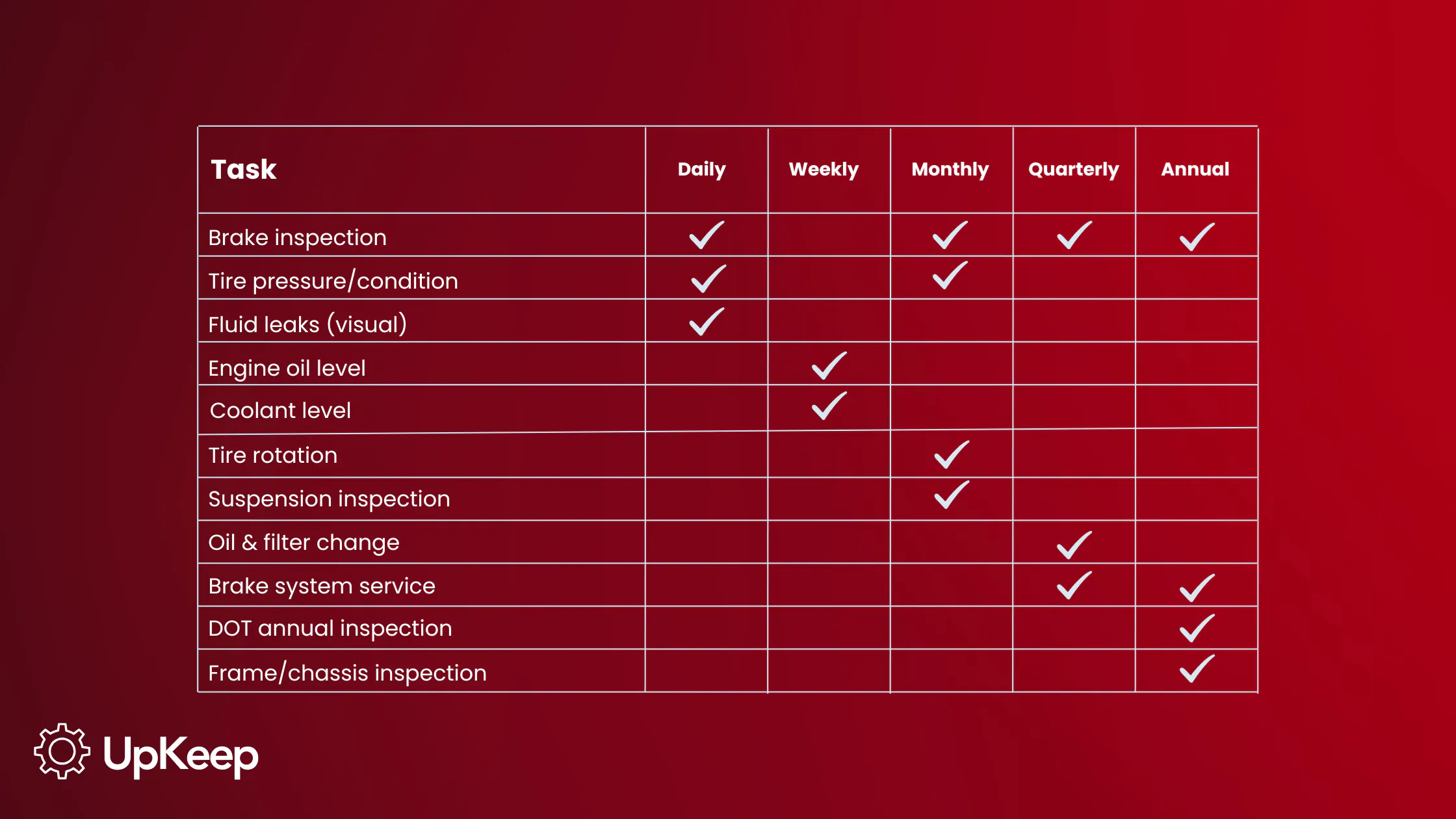
Fleet Maintenance Checklist by Frequency


How to Customize Your Fleet Maintenance Checklist
A standard checklist is a starting point, not a finished program. Different vehicle types, duty cycles, and operating environments produce dramatically different wear patterns. A checklist that fails to account for those variations will either provide excessive service for vehicles that don’t need it or neglect servicing those that do. Customization makes a checklist operationally accurate.

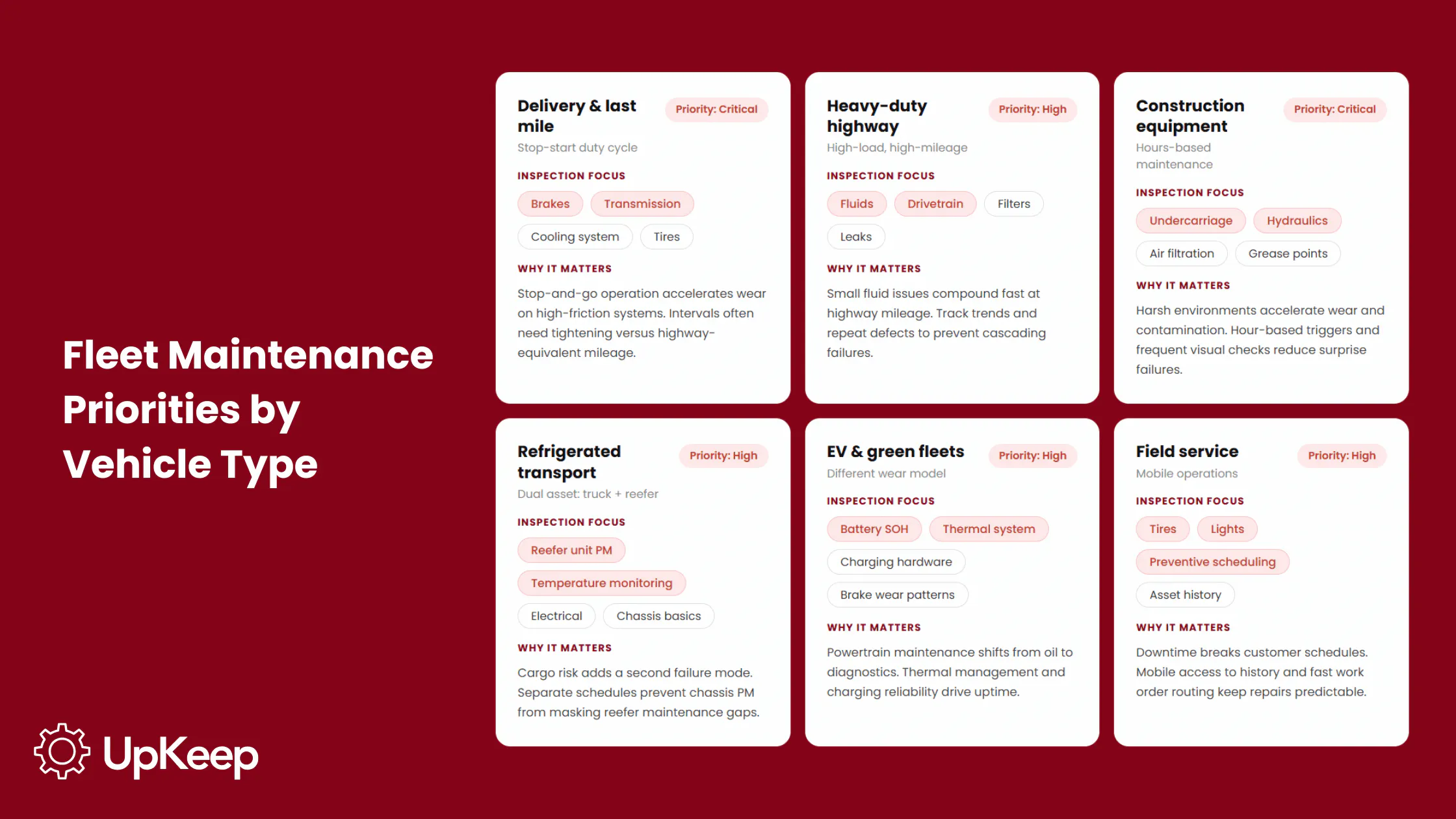
By Vehicle Type
Light-duty trucks operate within standard OEM intervals in most conditions. Follow manufacturer recommendations and adjust only when the duty cycle warrants it.
Medium-duty trucks carry heavier loads and experience more brake and tire wear than light-duty vehicles. Increase the frequency of brake pad checks and tire inspections relative to OEM standard intervals.
Heavy-duty trucks running highway routes can often extend oil change intervals but require aggressive monitoring of fluids, filters, and drivetrain components. Intervals vary significantly by engine and application, so always confirm against your OEM spec.
Construction equipment operates on engine hours, not mileage. Daily undercarriage inspections are essential on rough terrain, and hydraulic systems need weekly attention that standard vehicle PM schedules don't account for.
Delivery and last-mile vans experience brake and transmission wear faster than highway-equivalent mileage would suggest. Stop-start duty cycles are hard on these systems, so tighten intervals and prioritize monthly brake inspections over standard, mileage-based triggers.
Refrigerated trucks require two parallel PM schedules, one for the chassis and drivetrain, and another for the refrigeration unit. Temperature monitoring and refrigeration unit service are distinct from standard vehicle maintenance and need their own inspection frequency.
EV and green fleets require a different framework entirely. Battery state-of-health monitoring replaces oil checks as the primary mechanical health indicator. Regenerative braking changes how brake components wear, so inspection intervals need to reflect that difference.
By Operating Conditions
As previously stated, severe duty operations warrant tighter service intervals than standard OEM recommendations. Consult your OEM spec for guidance specific to your vehicle class rather than defaulting to standard intervals. Additionally, build seasonal priorities into the schedule before the time arrives, not after.
By Compliance Requirements
DOT-regulated commercial vehicles require daily DVIRs and annual inspections, as stated above. However, state-level emissions testing may also be mandatory and varies by jurisdiction. Confirm which laws apply in your operating region before finalizing your schedule.
How Digital Checklists Close the Gap Between Inspection and Repair
What happens after a defect is logged determines whether an inspection program prevents breakdowns or simply documents them.
With paper-based DVIRs, the gap between discovery and repair is inherent in the process: A driver notes worn brakes at the end of a shift and submits the form; it sits in an office until a dispatcher reviews it the next morning, creates a work order, and routes it to a mechanic; then, the repair finally occurs two to three days after the defect was first marked.
Digital checklists connected to a CMMS eliminate those gaps. When a driver notes a defect with a photo on a mobile device, a work order is immediately generated that includes vehicle details, a description of the defect, priority level, and the photo already attached. A supervisor receives a notification in real time and can schedule a repair the same day.
Step | Paper DVIR (Manual Workflow) | Digital DVIR + CMMS Workflow |
1 | Driver notes a defect on paper Limited detail, no photos | Driver logs defect in mobile DVIR Photo and notes captured at the vehicle |
2 | Form sits until processed Often reviewed at the end of shift or next day | Work order generated automatically Asset details attached instantly |
3 | Dispatcher reviews and creates work order Manual entry and prioritization required | Supervisor notified in real time Immediate triage and priority assignment |
4 | Mechanic receives ticket Often missing context or inspection details | Repair scheduled the same day Clear ownership and service priority |
5 | Parts ordered after diagnosis Delays increase if parts are out of stock | Parts workflow triggered automatically Parts reserved or reordered from inventory |
6 | Repair scheduled later Defect may remain in service longer than necessary | Audit trail stored automatically Timestamps, photos, and sign-offs recorded |
Outcome | Defects are documented but may not translate into action quickly enough to prevent downtime. | Defect → work order → notification → scheduling happen in one workflow, reducing downtime and audit risk. |
A CMMS-integrated digital checklist enables:
Auto-generation of scheduled inspection tasks at configured intervals: Daily DVIRs trigger before each shift, weekly checks on a fixed day, and quarterly PM at mileage thresholds
Instant work order creation from any logged defect, with full vehicle context attached
Completion rate tracking by driver, vehicle, and task type, making it visible when checks are skipped
Supervisor alerts for missed or overdue inspections before the gap becomes a compliance or safety problem
Offline mobile capability so drivers can complete inspections without cellular coverage, and the data will sync automatically when connectivity returns
Photo documentation with timestamps embedded directly in the work order, creating a defensible record
Audit-ready exports: When a DOT auditor requests 90 days of pre-trip inspection records, the report is generated in minutes rather than pulled after hunting through filing cabinets
Defect pattern reporting uncovers interval problems. For example, when a specific vehicle logs brake issues repeatedly within a short window, that’s a sign the inspection interval is too long for that asset’s duty cycle.
Consistent inspection completion and the resulting data allow fleet managers to make those adjustments based on measured wear patterns rather than assumptions.
How to Implement a Fleet Maintenance Checklist Program
Most fleets that struggle with checklist programs fail because completion isn't monitored, and accountability isn't built into the workflow. Implementation depends on follow-through, not just task configuration. To drive consistency and user buy-in, you need to:
Define checklist items based on OEM specs and FMCSR requirements. Know why each item is on the list and communicate that to drivers. When drivers understand what they're looking for and why it matters, adoption and thoroughness improve.
Add vehicles to your CMMS using VIN lookup to auto-populate make, model, year, and specifications. Accurate vehicle data from the start prevents configuration errors that impede PM scheduling.
Configure auto-generation triggers for each inspection frequency, such as daily DVIRs before each shift, weekly checks on a fixed day, monthly inspections on the first of the month, and quarterly PM at configured mileage thresholds. Manual scheduling risks tasks being forgotten or delayed.
Train drivers on mobile completion, including defect logging, photo documentation, and digital signature. Frame inspections as safety and cost prevention, not compliance overhead. Drivers who understand the operational value of inspections complete them more thoroughly than those who see them as paperwork.
Review completion rates weekly alongside your core fleet KPIs. For instance, low DVIR completion is a leading indicator that shows up later as emergency work orders and unplanned downtime.
Analyze defect trends monthly. Which components are flagged most frequently? Which vehicles generate the most defects? Consistent inspection data makes those patterns visible and enables you to act.
Adjust intervals based on failure data. If brake pads are consistently replaced well before the scheduled interval, the trigger is set too late for that vehicle's duty cycle. The program improves when its data feeds back into the configuration.
From Reactive to Controlled: What Changes When the Checklist Program Works
In reactive fleet maintenance, paper DVIRs are filed without triggering action. Defects are left for days before anyone schedules a repair, and PM occurs when a manager remembers to schedule it, not when the vehicle needs it. Although annual inspections happen, the documentation is stored in a filing cabinet that no one wants to open during an audit.
In a controlled fleet, however, defects generate same-day work orders, mileage-triggered PM runs automatically, and inspection records are exportable in minutes. The data from these consistent inspections then feeds back into the program, tightening intervals where wear patterns demand it, flagging vehicles that are draining disproportionate maintenance resources, and giving leadership the visibility to make informed replacement decisions.
The checklist is the input; fewer breakdowns, lower repair costs, stronger compliance documentation, and reliable service delivery are the outputs.
Modern CMMS platforms connect inspections, work orders, and parts to repairs in a single workflow that runs consistently regardless of who’s on shift. Managing trucks, equipment, and compliance records in one place is the difference between a maintenance program that exists on paper and one that keeps vehicles on the road.
Frequently Asked Questions
What should be on a daily fleet maintenance checklist?
For commercial vehicles subject to FMCSR Part 396.11, drivers must report any defects or deficiencies that could affect safe operation. In practice, daily inspections typically cover brakes (service and parking), tires (pressure, tread, and sidewall condition), lights and reflectors, steering mechanism, horn, windshield wipers, mirrors, and coupling devices where applicable. Most fleets also include fuel level, load securement, and safety equipment.
What's the difference between a DVIR and a PM checklist?
A DVIR is a driver-completed safety inspection performed before and after each trip to identify defects that make a vehicle unsafe to operate. A PM checklist is a technician-performed service schedule triggered by mileage, engine hours, or time. DVIRs detect emerging issues in real time, while PM checklists address predictable mechanical wear.
Which fleets are required to complete DVIRs under DOT regulations?
Commercial motor vehicles operating in interstate commerce are subject to federal DVIR and pre-trip inspection requirements under FMCSRs. This generally covers vehicles over 10,001 pounds GVWR, vehicles transporting passengers for compensation, and vehicles hauling placarded hazardous materials (49 CFR 390.5). Fleets operating intrastate or below those thresholds may face state-level requirements that vary by jurisdiction. Confirm applicability with your DOT compliance advisor.
What's the minimum documentation needed to pass a DOT audit?
DOT auditors typically request 90 days of DVIR records showing inspection date, driver signature, defects noted, and repair verification before the vehicle returns to service. Annual inspection records under 49 CFR Part 396.17 must include the inspection date, the inspector's credentials, vehicle identification, defects found, and repairs completed. Incomplete or unsigned records are considered violations even if the inspections were performed.
What happens when a driver logs a defect? Who is responsible for follow-up?
The driver’s responsibility ends once the defect is accurately logged. Responsibility then shifts to the fleet manager or maintenance supervisor to review severity and determine repair priority or out-of-service status. In CMMS-connected workflows, this handoff occurs automatically through work order generation and supervisor alerts.
How do you improve checklist completion rates?
Completion gaps typically occur because the process is too cumbersome, accountability isn't visible, or drivers don't understand why the inspection matters. Improve performance by enabling mobile inspections at the vehicle, making completion metrics visible to drivers, and reinforcing the operational consequences of missed defects.
MÁS DE 4000 EMPRESAS CONFÍAN EN LA GESTIÓN DE OPERACIONES DE ACTIVOS
Liderando el camino hacia un futuro mejor para el mantenimiento y la confiabilidad
Los datos de sus activos y equipos no pertenecen a un silo. UpKeep simplifica ver dónde se encuentra todo, todo en un solo lugar. Eso significa menos conjeturas y más tiempo para concentrarse en lo que importa.






![[Review Badge] Gartner Peer Insights (Dark)](https://www.datocms-assets.com/38028/1673900494-gartner-logo-dark.png?auto=compress&fm=webp&w=336)