Entrada en el Blog
¿Cuáles son los KPI principales de un administrador de instalaciones?
Los indicadores clave de rendimiento son conjuntos de datos que brindan a los gerentes de las instalaciones información crítica sobre sus instalaciones.



Facility Management KPIs to Increase Productivity and Improve Facility Operations
Interested in how other facilities track KPIs? Key Performance Indicators are extremely valuable in determining the efficiency of your maintenance team and facility status.
What are the key performance indicators (KPIs) for facility managers?
Key performance indicators, or KPIs, are sets of data that provide facility managers with important information on the current state of the facilities they manage and how current practices align with business goals. They help facility managers pinpoint problem areas and make plans for improved reliability, sustainability, safety, and regulatory compliance. In addition, KPIs provide insight into how current plans are panning out.
Key Performance Indicators vs. Facilities Management Metrics
Key performance indicators are often confused with metrics, but the two are actually a bit different. Facilities management metrics are single points of data with no objective in mind, whereas KPIs are measurements that show how well a facility is meeting its objectives. As such, a KPI might draw upon multiple metrics to create one cohesive measurement.
For example, a measure of total maintenance hours would be a metric, while planned maintenance vs. reactive maintenance would be a KPI. One is a simple measurement, while the other compares two points of data to show how well the facility keeps up on equipment maintenance tasks.
The importance of Key Performance Indicators (KPIs) in facilities management
KPIs support facilities management by giving concrete data to show exactly how a facility is performing. That data prompts important discussions and informs maintenance planning. When used over time, KPIs help organizations set targets and meet them with clear, data-driven planning.
14 Primary KPIs for facilities managers to keep track of:
When working to improve facility operations and productivity, there are many KPIs that can help. The following provides a well-rounded basis for maintenance and reliability planning.
1. Employee (user) satisfaction score
An unhappy workforce might be a symptom of underlying issues that are harming productivity. There might be something preventing them from completing their jobs—therefore resulting in lower satisfaction—or there may be unsafe working conditions. Either way, unhappy employees will generally lead to a high turnover rate, which increases staffing costs.
2. Workforce productivity
The overall productivity of your workforce indicates how well your employees are able to complete tasks on time. If it’s low, it might mean there’s something getting in the way of productivity, or it may simply be the result of low morale.
3. Work Order resolution times
The time it takes to complete maintenance work orders shows the efficiency of your maintenance planning and workflows. If work orders seem to be taking an inordinately long time to complete on average, it may be a sign of poor planning or obstacles in the process that slow completion. In the end, slow resolution times can impact reliability as preventive maintenance tasks aren’t completed on time.
4. Gross Facilities Management Costs per 1 m² or 1 ft²
Measuring gross FM costs per square foot can give facility managers a ballpark idea of how much budget they need to keep the facility running. The average figure varies by industry, so it’s worth looking at this KPI overtime to get the best results. An overly high cost may mean more budget is needed, or it may indicate a need for streamlining processes somewhere.
5. Planned maintenance vs. reactive maintenance ratio
Ideally, you should be performing more planned maintenance than reactive maintenance. If your time spent on reactive maintenance gets above a certain threshold when compared to your planned maintenance, you likely aren’t keeping on top of necessary preventive tasks. Either prevention is not the priority it should be, or there’s something getting in the way of completing PMs on time.
6. Number of employee (user) complaints
A high number of employee complaints may indicate poor management practices, unsafe work conditions, poor maintenance practices, toxic working environments, or similar issues. The number—and nature—of these complaints can provide valuable insight into facilities management practices.
7. Maintenance costs per 1 m² or 1 ft²
As with facility management costs per square foot, maintenance costs per foot or meter squared give facility managers an idea of how much budget they need. In addition, tracking this number over time can provide insight into whether maintenance processes are improving or deteriorating. An increasing number may warrant an investigation into asset health, workflow efficiency, and other related metrics.
8. Operations costs 1 m² or 1 ft²
Operations costs per square foot give facility managers an idea of how well their equipment is maintained, how efficiently their workforce is utilized, and what budgetary changes might need to take place. If operating costs increase over time, there may be an issue with the way assets are being maintained. If they’re decreasing, it could show that current plans are having a positive impact.
9. Utility costs per 1 m² or 1 ft²
Utility costs per square foot show the amount of electricity, heating, cooling, etc. that are needed to keep the facility running. An abnormally high cost could warrant switching to more efficient assets (like high-efficiency bulbs) or tuning up utility equipment (such as heating and cooling systems). In some cases, the workplace culture may need to shift, such as if employees tend to wastewater or electricity when performing work-related tasks.
10. Cleaning costs per 1 m² or 1 ft²
Keeping equipment and workplaces clean is important, but if the cost seems to be increasing too much over time, there may be an issue with how it’s being performed or even on the current state of the facility’s assets. On the other hand, decreasing costs may either mean there are less frequent messes, or the facility isn’t keeping up on cleaning tasks the way it should.
11. Security costs per 1 m² or 1 ft²
Security is important to facilities management, but it does have its associated costs. Tracking security costs per square foot helps facility managers plan the amount of budget needed to keep property, assets, and employees secure. If the cost seems a bit high, there may be a need to switch to a more cost-effective system.
12. Reactive Maintenance versus Preventative Maintenance over time
As with planned versus reactive maintenance, tracking preventive maintenance versus reactive over time gives facilities managers a sense of how maintenance processes are being executed. Favorable trends show that the team is staying on top of PMs and taking proper care of equipment.
This is important to know from a facility management KPI perspective because we always want to see some sort of relationship and trend for our reactive or corrective maintenance compared to our preventative. Is there anything we can do to prevent issues from arising?
13. Money spent on new equipment versus repairs
Somewhat tied to the above, but at the end of the day, we want to be spending our budget on new equipment, new upgrades, then spending money on replacements and repairs. We are looking for trends here again over time so that we can find some sort of actionable data
14. Average completion time or response time for work submitted
Should be self-explanatory, BUT the time to respond to work orders, who has done it, and the time from open to close is always very important as well.


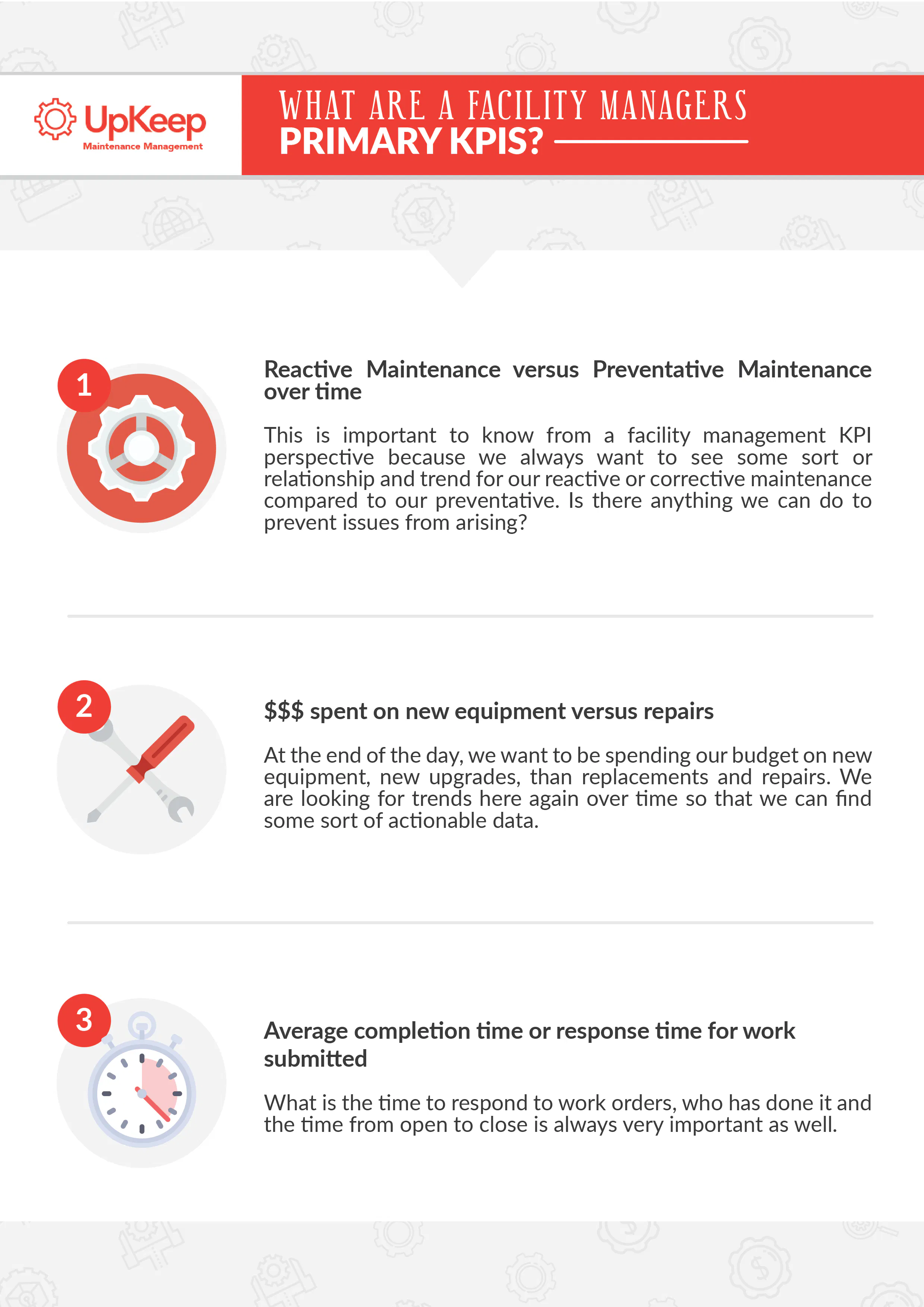
Infographic: What is a Facility Manager’s Primary KPIs?
Common data sources for measuring KPIs:
FM Information System
Finance System
Staff
Internal Surveys
Utility Companies
Service Companies
Vendors
Building Automation System
Energy Management System
Other Internal Systems
The Ultimate Guide to Maintenance Metrics & KPIs
Download this FREE 18-page guide that includes overviews, formulas, strategies, and tips for pinning down the right metrics to track. As a bonus, we’ve included a helpful formula guide for quick reference!



MÁS DE 4000 EMPRESAS CONFÍAN EN LA GESTIÓN DE OPERACIONES DE ACTIVOS
Liderando el camino hacia un futuro mejor para el mantenimiento y la confiabilidad
Los datos de sus activos y equipos no pertenecen a un silo. UpKeep simplifica ver dónde se encuentra todo, todo en un solo lugar. Eso significa menos conjeturas y más tiempo para concentrarse en lo que importa.






![[Review Badge] Gartner Peer Insights (Dark)](https://www.datocms-assets.com/38028/1673900494-gartner-logo-dark.png?auto=compress&fm=webp&w=336)