Blog Post
S2:E29 Reliability Leadership and Organizational Culture with Joe Adam
In this episode of Masterminds in Maintenance, we are excited to have Joe Adam, Manager of Engineering and Maintenance at Roche, on the show!


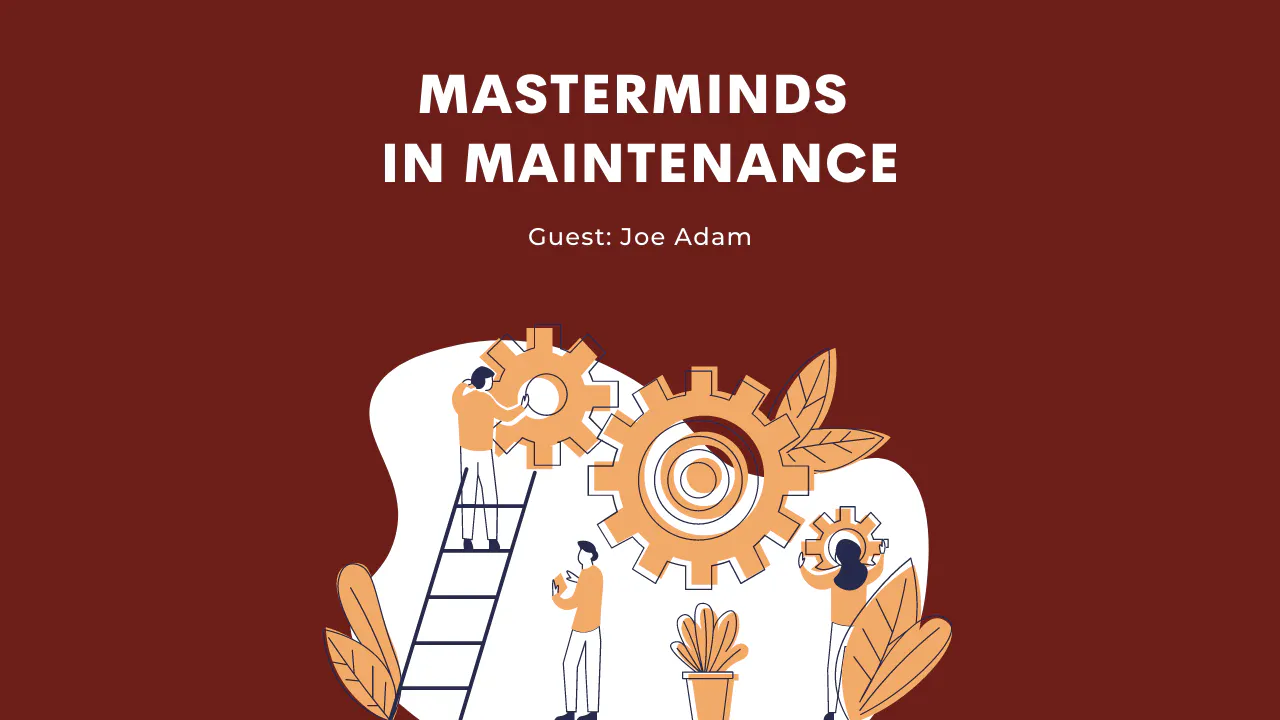
Joe Adam is the Manager of Engineering and Maintenance at Roche, and holds over 20 years of experience in the maintenance and reliability industry!
Summary
In this week's episode of Masterminds in Maintenance, we are excited to have Joe Adam, Manager of Engineering and Maintenance at Roche, on the show! Joe and Ryan discuss organizational culture in the maintenance and reliability industry, and how organizations in this industry can build up individual contributors to leaders! Listen today!
[Embedded content: https://anchor.fm/upkeep/embed/episodes/S2E29-Reliability-Leadership-and-Organizational-Culture-with-Joe-Adam-erua3d]
Episode Show Notes
Podcast Platforms
Transcript
0:00:04.2 Ryan: Welcome to Masterminds in Maintenance, a podcast for those with new ideas in maintenance. I'm your host, Ryan, I'm the CEO and founder of UpKeep. Each week I'll be meeting with a guest who's had an idea for how to shake things up in the maintenance and reliability industry. Sometimes the idea failed, sometimes it made their business more successful, and other times their idea revolutionized an entire industry. Today, I'm super excited to have Joe Adam here on the show. A little bit about our guest, Joe is the manager of engineering and maintenance at Roche. He holds over 20 years of experience in the maintenance and reliability industry. So welcome, Joe, to the show, I'm really excited to have you.
0:00:38.4 Joe Adam: Hey, thanks for having me on, Ryan, I'm excited to be here and kinda talk about maintenance and reliability with you guys.
0:00:45.3 Ryan: Alright, our favorite topic. The way that we always kick things off, Joe, is have you share a little bit more about your background and how you were first introduced to this wonderful field of maintenance and reliability.
0:00:57.0 JA: I've worked, like you stated, over 20 years, primarily in maintenance operations, engineering roles, and really, I got started in maintenance and reliability in my first full time job out of college. I was working in the steel industry as an electrical maintenance foreman, expanded roles through engineering and then maintenance management, spent some time in the automotive industry, and right now, in the medical device industry.
0:01:23.1 Ryan: You've moved up the ranks over the past 20 years, going from the technician, all the way to a manager at a very, very well-known company now, which kind of leads me and us into this first topic around leadership, culture, and also, org structure and design. From your experience, what is org culture in maintenance and reliability companies? What's that like? And is there a lot of upper movement in maintenance and reliability organizations? How do you basically make that transition from a, let's call it, an individual contributor to a leader and a manager?
0:02:00.0 JA: One, it's the culture of the company that you're at or the organization you're in. And a lot of it's also the ability, or really, the drive of the individual and how they can meet up and help that individual with whatever their career aspirations are. I've been a part of a lot of companies where you'll see a lot of the front line supervisors have came from those traditional skill trades or the hourly ranks, and primarily, what you see in those organizations is because there's those front line supervisors or foreman type roles, are more of the hands-on coaching roles to help develop those skill trades, and in some cases, they're actually there to also get dirty with them to make it easier to stay. And in those organizations, typically what you'll see is those skill trades, that's about as far as they'll, they can go, either because it just takes so long to get through the imprudence program, like say, in a union shop, then to get to supervision, and by then, they've kind of said, "This is as far as I wanna go in my career." There's a ceiling when you stay within the silo of maintenance and reliability in a lot of organizations. And if you wanna progress, you almost have to go a little bit horizontal and get into maybe more of the production and operation side, and that also helps you keep balance. You can see both sides of the story.
0:03:29.0 JA: There's another hurdle that's out there in certain industries that I've seen too, a lot of organizations put a lot on formal education credentials, and that's a burden, a lot of skilled trades, individual contributors, that's just not their thing. That's why they went the skilled trades route, they didn't wanna go get a four-year college degree. Though that's a good screening tool, some of the best leaders I've seen are really peer leaders, and they've shown that ability to influence people, coach them up, and they didn't learn that in college.
0:04:06.9 Ryan: You brought up a good point of like when you move horizontal, you get more exposure into production operations and that enables you to have a bigger scope outside of just, let's call it, maintenance. Joe, you mentioned a little bit about your path, but I would love to peel back the onion there and hear a little bit more about how you went from individual contributor to manager to leader.
0:04:29.1 JA: I actually started off as a frontline supervisor, United Steel Workers Union. Everybody that worked for me at the time was actually older than my dad was, so of course, I got a lot of flack for being the young guy. But you learn a lot in that role, and then I went to an individual contributor role 'cause I wanted to get a sense of what it was like from an engineering perspective, since my degree was in electrical engineering, be more of that driver without having to be responsible for people. Within the first seven years, I had done both jobs and I figured out, well, I really like the people leadership side. And then from there, just kind of move to different companies, going from operations in the auto industry to now back into maintenance and engineering.
0:05:14.8 Ryan: We have or I have been traditionally in this, let's call it, silo of maintenance and reliability. Do you have any tips, tricks, advice for me to try to move up and get broader exposure, what worked for you, what didn't work for you, to grow my own leadership capabilities within the company that I'm at?
0:05:34.3 JA: It comes to understanding what your strengths are, what your weaknesses are as an individual leader and play to your strengths. I know a lot of people wanna focus on, well, let's fill the gaps of what your weaknesses are. But one thing that I've learned, you work on some of your weaknesses in practice, but when you get this game time, you really leverage your strengths. You're not gonna have Wilt Chamberlain play point guard for you. Broaden your knowledge within the organization, whether it's within your silo, and since we're talking maintenance and reliability, I mean there's always continuous learning, and the more that you learn and the more different ideas that you can bring to the group to try to foster that reliability journey and move the organization forward, will help you within that department, but that also then has ancillary benefits from an operation standpoint, 'cause if you're improving the asset health, the operations team's getting the reward of that, in essence. And you can then start collaborating with them more and work on continuous improvement projects within that cross-functional area.
0:06:45.5 Ryan: It's all about taking initiative. It's not only about just what you think and what you know you're really good at, but when these opportunities arise, and they always do from time to time, raise your hand and say, "Yeah, I'll take this on." Taking these opportunities gives you that broad exposure that'll help you down the road in many, many ways.
0:07:04.4 JA: That's one thing that I think leaders need to do to help their employees that want to better themselves, is identify, "This is what their strength is." And it doesn't appear that either, maybe because if they're anxious or what not, you have to give them a little bit of platform to kind of grow into getting out on that edge or getting out on that plank a little bit and realize that, hey, you gotta give them a little bit more rope than maybe you would a more seasoned person that's more experienced in doing something, if this is a new activity you're trying to push them towards.
0:07:39.6 Ryan: A lot of organizations are... They kinda take status quo as status quo, but I think what we talk a lot about on these podcasts is actually a lot of change, like how can you inspire others, how can you invoke change that's needed within an organization. A lot of that starts by developing the people that exist at the organization today and developing, especially leaders. So maybe the question here, Joe, is like, what do you think more organizations should be doing to cultivate more leadership, more reliability leaders within a company?
0:08:18.7 JA: Really, it's getting exposure, being transparent on what that reliability journey is for your team. I lead a group right now, we're about 55, we're gonna grow to about 70 here in the next year, and what we've done in the last couple of years is we have a strategy team and we meet monthly and have a workshop annually, where we kinda talk about where are we gonna go in the next year from our reliability journey, what elements are we gonna focus on. For 2021, we're gonna pick three, but we let the whole organization know, the whole department know, what are those elements we're gonna focus on. We have the strategy team kind of lead the improvement activities, but we include the entire department, based on their willingness to learn or to, like I said, where is their strength and where can they help us in driving that improvement. A lot of organizations need to do too is get them exposure to more of the higher level reliability strategies and tactics. In our organization, we don't have titled reliability engineers, we have that as a part of different people's job descriptions, whether it's the manufacturing engineers, the leadership team. Prior to us weighing out a road map like we've done, it was kind of a crap shoot.
0:09:43.9 JA: Everybody was pulling at something else that they read, but we actually put together a road map and say, "This is the direction we're going, we're gonna pull in the information and we're gonna teach everybody and use the same nomenclature, so that everybody is learning along the way." They might not understand all the concepts within it, but as we're learning more and the strategy team learns more, we share that with the whole group, and then as people gain interest in what we're doing, there's volunteer opportunities for them to join us and get together with those cohorts and drive those improvements.
0:10:21.8 Ryan: Yeah. That sounds like a great opportunity. And it's really interesting too that it sounds like there's no single person, single department that's responsible for reliability, it's literally everyone's job, it's baked into the job description. And I think that there is actually a really interesting opportunity there for org design, making sure that everyone has a little piece of reliability in their responsibilities.
0:10:46.7 JA: If you think about it, everybody has a little bit of a responsibility when it comes to safety, everybody has a little bit of responsibility when it comes to product quality, no matter what your role is within the organization, but... And this is something I think organizations can improve on, everybody needs to have a little bit of role within reliability and how they treat the equipment 'cause a good part of that is, there's a whole concept of operator-driven reliability, and it usually falls into that traditional TPM autonomous maintenance, the most simple task that an operator can do to ensure a good operation of the equipment is keep it clean.
0:11:30.9 Ryan: As you look at the future of maintenance and reliability, what gets you most excited about the industry and tools, technology, processes, anything.
0:11:42.0 JA: Really what's got me excited, I guess, for my team. I'll just speak for my team, we've been on a journey and we're seeing progress, but with this pandemic, it's kind of put... Like I told some guys today, 2020 was a mulligan, so it'd be interesting to get our momentum back going into 2021 and see where our journey goes, but there's a lot of neat things happening in the condition-based space, and then when you tie that into what's going on with the Internet of things in terms of maintenance and reliability and how those tie together, it'll be very interesting 'cause that'll help with a lot of the data analytics and being more proactive and, I guess, prescriptive with your maintenance.
0:12:26.3 Ryan: It's a journey to get there, and everyone's at different maturity models around, let's call it, predictive-prescriptive maintenance. What's something that you wish more people knew about within the maintenance and reliability industry?
0:12:39.2 JA: Though they are kind of tied together, like I just mentioned, there are subtle differences. When you're thinking reliability, you're thinking more long-term, and you can't have a day trader's mentality when you're on a reliability journey. Whereas maintenance, in and of itself, is, hey, I'm gonna keep the asset to a certain standard and repair it to meet that standard, and reliability, you're looking at the long-term, how your process is performing, is it performing its intended function for the duration of however long that life cycle is meant to be, and then what do you gotta do to design out any inherent flaws that were designed in. Because I think that's one thing that gets lost on a lot of journeys. You're trying to fight an uphill battle. You're trying to do things to your equipment or with your equipment that was never designed in initially, you had a poor foundation at the very beginning, and you gotta overcome those hurdles before you can get to where you wanna go.
0:13:41.6 Ryan: Alright, Joe, really appreciate it. Loved the conversation today. Can you share with our listeners all the different ways that they can connect with you and follow you on your journey?
0:13:50.4 JA: Yeah, I mean, overall, the best way to follow me or get in touch with me is via LinkedIn, and that's kind of where I keep all my professional stuff, I'm also a member of the SMRP, so I can get reached through there. I'm actually on the Indiana chapter board for SMRP. So anybody around the state of Indiana, look us up on LinkedIn, we have our own page for our own events for the Indiana chapter.
0:14:14.9 Ryan: Thank you again, Joe, for joining us. Thank you to all of our listeners for tuning in to today's Masterminds in Maintenance. My name is Ryan, I'm the CEO and founder of UpKeep. You can connect with me on LinkedIn or shoot me an email directly at [email protected]. Lastly, you can also find me in the maintenance community, the largest online community of maintenance professionals in the world, we host weekly conversations and contests all centered around maintenance and reliability, so I hope to connect with you all soon. Until next time. Thanks again, Joe, really appreciate it.
0:14:43.3 JA: Yeah. Thanks, Ryan.
Be a part of the world's first Slack Group solely dedicated to those in the maintenance and reliability industry!
Connect and network with over 3,000+ professionals working across 20+ different time zones, attend and receive recordings of free webinars and workshops, ask questions and engage in live discussions with industry experts, and so much more!
Sign up now and meet with maintenance and reliability professionals today!
Join the Masterminds in Maintenance Podcast!
4,000+ COMPANIES RELY ON ASSET OPERATIONS MANAGEMENT
Leading the Way to a Better Future for Maintenance and Reliability
Your asset and equipment data doesn't belong in a silo. UpKeep makes it simple to see where everything stands, all in one place. That means less guesswork and more time to focus on what matters.





![[Review Badge] Gartner Peer Insights (Dark)](https://www.datocms-assets.com/38028/1673900494-gartner-logo-dark.png?auto=compress&fm=webp&w=336)