How to Prioritize Maintenance Work Orders (And Stop Fixing the Loudest Problem First)
Key Takeaways
-
A written priority system replaces the “whoever shouts loudest” dynamic with criteria-based triage. Without defined tiers, work is prioritized by who follows up, not by asset risk or operational consequence.
-
Asset criticality is what separates an emergency from a scheduled repair. The same pump failure can be a P3 in one area and shut down production as a P1 elsewhere. The difference comes down to where it sits in the operation.
-
A scoring model removes the guesswork from triage decisions. When safety, criticality, and downtime costs are scored consistently, the queue holds its shape across shifts rather than changing with whoever manages it.
-
PM work orders don’t maintain their position without protection. They get pushed, then missed, then come back later as failures that cost more to fix and take longer to recover from.
-
Work order prioritization only works when it’s built into the intake workflow. When tiers and escalation rules are applied at intake, the queue reflects risk consistently across shifts.
When there’s no formal system for ranking work requests, the queue fills in the order requests come in, influenced by who follows up.
A manager may take three calls in the same hour from facilities, production, and fleet. Each one sounds urgent. The last one tends to get immediate action. Meanwhile, the overdue oil change stays open, while a P2 compressor issue sits because it came through email instead of a call.
Over time, that pattern shows up in the numbers: Emergency work goes up, PM completion slips, and MTBF starts to drop. The work that was supposed to prevent failures ends up reappearing as the failures themselves.
A work order prioritization system changes what the queue reflects. Rather than the urgency perceived by the requester, it reflects safety exposure, asset criticality, and downtime cost. That shift happens at intake, not later, and it holds across shifts.
What Work Order Prioritization Is and How It Works
Work order prioritization is the process of ranking maintenance requests by safety risk, asset criticality, and downtime cost so technicians address the right work in the right sequence.
Responding to whoever asked most recently isn’t a prioritization system. A real system assigns a measurable score to each incoming request based on the impact on operations if the work isn’t done, and then ranks the work accordingly.
For fleet operations, that means scoring requests against vehicle availability, route criticality, and DOT compliance exposure. A brake defect on a primary delivery truck and a cabin HVAC complaint belong in different priority tiers.
For facilities, it means separating production-critical equipment failures from general maintenance requests. A compressor fault in the main production area doesn’t rank the same as a lighting replacement in a break room.
Why Maintenance Work Order Prioritization Breaks Down Without a System
Reactive Work Dominates the Schedule Fast
When something breaks, someone calls, and it gets immediate attention. PM work orders don’t show up the same way. Nothing’s broken yet, so they sit. Without a rule protecting it, planned maintenance gets pushed.
The schedule fills with reactive work, and the PM backlog starts to build with deferred oil changes, skipped belt inspections, and overdue filter changes. They then come back later as emergency repairs the team was trying to avoid in the first place.
The Squeaky Wheel Problem Skews the Queue
Requests from more visible teams or from people who follow up tend to be handled first, even when the risk sits somewhere else. A facilities director who calls daily moves their requests up the queue regardless of what actually matters to operations. A DVIR (Driver Vehicle Inspection Report) defect logged by a driver on night shift is neglected since no one follows up.
Shift Inconsistency Creates Priority Drift
Without documented criteria, the decision depends on who’s managing that shift. A failure classified as P2 on the day shift may be classified as P3 on the night shift because the night supervisor applies a different judgment. Over time, “the system” just becomes whatever the manager thinks it is.
The Backlog Hides the Problem Longer Than It Should
Without age tracking and tier visibility, managers don’t know which open work orders are overdue until they’ve caused a failure. A P3 item that should have been completed two weeks ago can look the same as something that came in that morning. By the time it becomes a P1, the damage is already done.
Work Order Priority Tiers: A Practical Framework
Four tiers cover the full range of maintenance requests without making the system so complex that it breaks down in practice. Each tier is defined by what happens operationally if the problem isn’t fixed, rather than by how urgent it feels to the person submitting it.
|
Tier |
Level |
Definition |
Fleet Examples |
Facilities Examples |
|---|---|---|---|---|
|
P1 |
Emergency |
Safety hazard, total production stoppage, or compliance-critical failure. Immediate action required. |
Critical brake defect on DVIR; active DOT violation; engine failure mid-route |
Equipment posing injury risk; production system failure; fire suppression fault |
|
P2 |
High |
Significant operational impact; equipment at risk of failure within 24-72 hours. Redundancy may cover the gap. |
Tire wear beyond threshold; brake pad at minimum; refrigeration unit underperforming on temperature-sensitive route |
HVAC running at reduced capacity in a production area; compressor fault with backup online |
|
P3 |
Medium |
Scheduled repair with operational consequences if deferred past the next service window. Includes overdue PMs and non-safety DVIR items. |
Overdue oil change; wiper blade replacement; cabin HVAC performance drop |
Scheduled belt replacement; minor conveyor performance degradation; overdue filter change |
|
P4 |
Low / Routine |
Deferred work with no immediate operational impact. Scheduled by available capacity. |
Paint touch-up; interior cleaning; non-critical lighting replacement |
Aesthetic repairs; furniture upgrades; minor facility improvements |
Tier definitions serve a second purpose as well: They close the door on priority drift. When a P1 is defined as a safety hazard or compliance-critical failure requiring immediate action, there’s no room for interpretation across shifts or managers; everyone works from the same criteria.
How to Prioritize Work Orders Using a Weighted Scoring Matrix
A four-tier framework defines what each level means. A weighted scoring matrix determines which tier an incoming request belongs to without requiring a judgment call from whoever receives it.
Many teams formalize this as a work priority index (WPI), a weighted score that ranks requests consistently across the entire backlog.
This approach aligns with reliability-centered maintenance practices, where work is prioritized based on risk rather than request order. Its criteria focus on:
-
Safety impact
-
Asset criticality
-
Downtime cost
Each is scored on a 1 to 5 scale and weighted based on operational importance. Safety impact carries the highest weight. Any request introducing risk of injury or regulatory exposure scores maximum points and nearly guarantees a P1 assignment regardless of the other dimensions.
Asset criticality comes down to one operational question: How important is this asset to current operations? For example, a failed HVAC unit in a server room is critical. There’s no redundancy, and a temperature breach damages equipment. The same failure in a storage area isn’t severe.
On the fleet side, a vehicle on a primary distribution route scores higher than an identical vehicle sitting in the yard awaiting assignment.
Downtime cost separates a line-down event from a support function going offline. A conveyor failure stopping production isn’t equivalent to a break room appliance fault, even if both land in the queue in the same hour.
Once the three dimensions are scored and weighted, the composite total determines the tier. The scoring matrix’s value is consistency; the same criteria applied at intake produce the same tier classification at 8 a.m. on Monday and 11 p.m. on Saturday, regardless of who’s managing.
|
Dimension |
Weight |
Score: 1 |
Score: 3 |
Score: 5 |
|---|---|---|---|---|
|
Safety Impact |
3x |
No injury risk; no regulatory exposure |
Possible injury risk or partial compliance gap |
Immediate injury risk or active regulatory violation |
|
Asset Criticality |
2x |
Non-production asset; redundancy available |
Production support asset; limited redundancy |
Production-critical; no redundancy; fleet route-essential |
|
Downtime Cost |
1x |
Minimal disruption if the asset goes offline |
Moderate disruption; workarounds available |
Line-down event or full fleet route stoppage |
For example, a brake defect on a DOT-regulated vehicle may score a 5 on Safety Impact (x3 = 15) + a 5 on Asset Criticality 5 (x2 = 10) + a Downtime Cost of 3 (x1 = 3), totaling a composite score of 28, which maps to P1. A non-structural lighting fault may score a Safety value of 1 (x3 = 3) + 1 for Criticality (x2 = 2) + and 1 for Downtime (x1 = 1), giving it a composite score of 6, which assigns it to P4.
Where Preventive Maintenance Fits in Work Order Prioritization
PM work orders don’t arrive with an obvious urgency signal. Equipment isn’t down, no one’s calling. The service interval is approaching or has already passed, but the consequences of skipping it are invisible until something breaks. That structural invisibility is the reason PM work is displaced by reactive requests, and why a prioritization system needs an explicit rule to protect it.
Overdue PMs should escalate automatically. PM missing its trigger by more than a defined threshold, whether measured in mileage, operating hours, or calendar days, should move from P3 to P2. The threshold makes the risk visible before a failure makes it unavoidable. A vehicle 500 miles past its oil change interval, for instance, carries a different risk profile than one 50 miles past, and the priority system should reflect that.
Usage-based PM triggers carry greater operational weight than calendar-based ones. A work order generated at 7,500 miles of verified use is easier to defend in the schedule than one activated by an arbitrary date. When a technician can see the actual wear threshold that opened the work order, reactive pressure has less room to override it.
The preventive-to-reactive ratio tells you whether PM work is holding its position. When reactive work orders represent a consistently high share of total volume, PM work is losing the competition for technician time. That ratio should trend toward more preventive work as the PM program stabilizes. A flat or worsening ratio means reactive pressure is winning.
For facilities teams, HVAC, compressor, and production equipment PM compliance should be tracked separately from general facility work orders. A 90% overall PM completion rate can hide a 60% completion rate on production-critical assets, and that distinction is where the risk actually lives.
How to Build a Work Order Priority System in Your CMMS
Without a connected system, prioritization depends on individual judgment at every handoff. A work request arrives by email, phone, or paper form. A manager reads it, decides the priority based on available context, and assigns it or doesn't, depending on what else is pressing. The P3 item that wasn't urgent enough to assign on Monday ends up sitting in the queue the following week. Nobody escalated it because nobody flagged it.
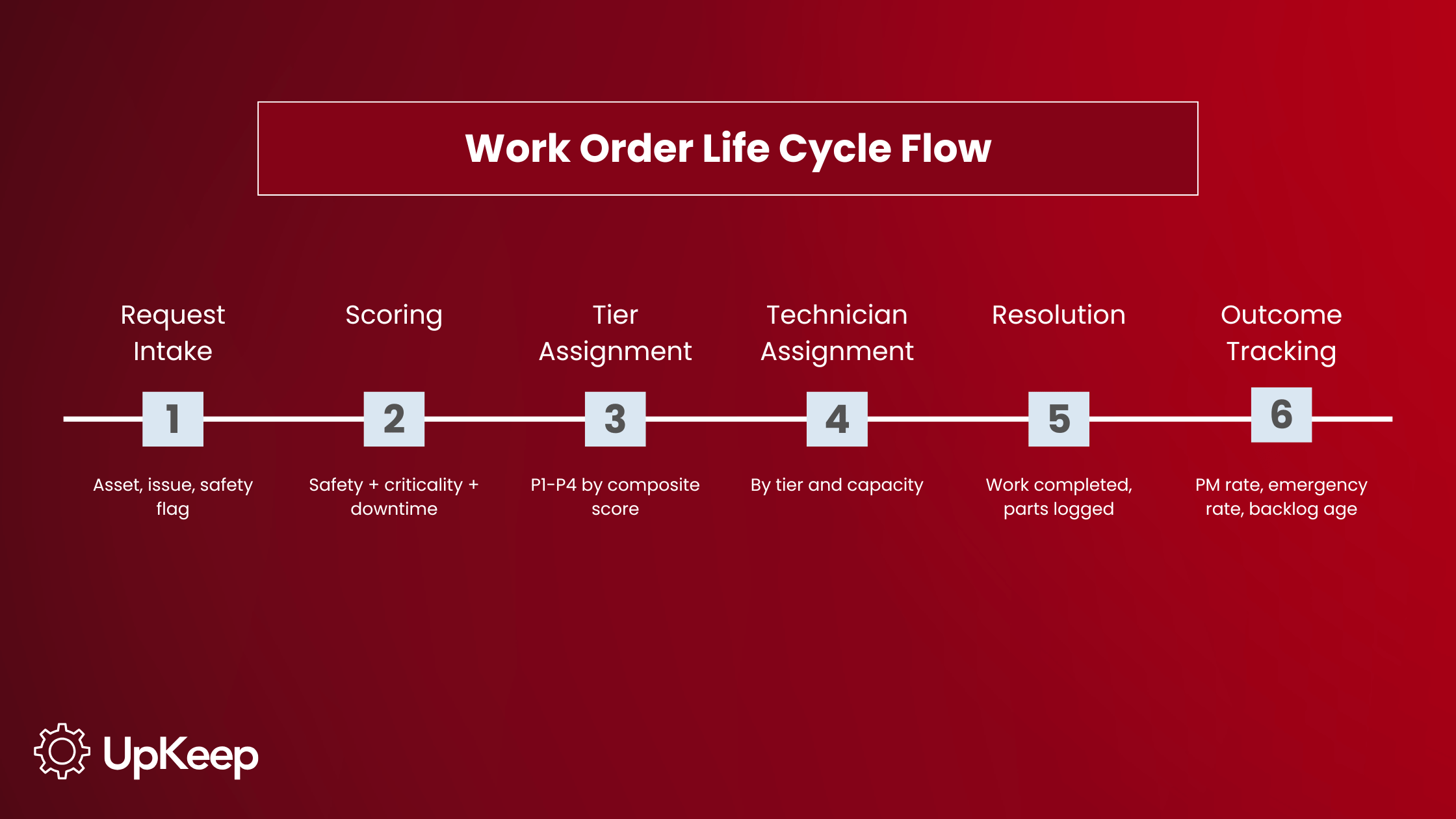
A CMMS closes each of those gaps by encoding the prioritization logic into the intake workflow itself:
-
Step 1. Define asset criticality tiers before the first work order is classified. Every asset needs a criticality rating: production-critical, operations-support, or non-critical. This is a one-time setup, reviewed annually. Once done, asset criticality feeds directly into the scoring matrix, eliminating the need for the manager to reconstruct it each time.
-
Step 2. Build priority criteria into the intake form. When a requester submits a work order, they select the asset, describe the issue, and flag any safety implications. The system uses that input to generate a preliminary composite score and suggest a tier. The manager confirms or overrides it with a documented reason.
-
Step 3. Configure escalation rules so P3 items aging past a defined window move to P2. Overdue PMs escalate by tier as the interval gap grows. Escalation rules enforce the system when manual review doesn’t happen, which in a busy shop is often.
-
Step 4. Review the open backlog by priority tier and age weekly. A filtered backlog view, sorted by tier, then age, surfaces items drifting past their service window before they cause a failure. A P2 open for 96 hours signals a capacity or triage problem. Either way, it’s visible.
-
Step 5. Track outcomes. Emergency work order rate, PM compliance percentage, backlog age by tier, and preventive-to-reactive ratio are the four metrics that tell you whether the system is working. Rising emergency rate combined with dropping PM compliance means reactive work is winning, and the system needs adjustment.
UpKeep centralizes this workflow. Asset criticality is stored at the asset level, work order intake captures the scoring inputs, escalation rules fire automatically, and the backlog view filters by priority tier and age. Emergency repair volume drops as PM compliance holds.
Maintenance Metrics That Gauge Your Priority System’s Success
The five metrics below give a complete read on whether the prioritization system is functioning or starting to break down.
|
Metric |
What It Measures |
Warning Signal |
|---|---|---|
|
Emergency work order rate |
Percentage of total work orders classified P1 |
Rising quarter-over-quarter means reactive volume is increasing and PM work is losing ground |
|
PM compliance rate |
Percentage of scheduled PMs completed on time |
Track separately for production-critical assets; a strong overall rate can mask a low rate on critical equipment |
|
Work order backlog age by tier |
Average days open for P2, P3, and P4 items |
P2 items open past 72 hours signal a capacity or triage problem; P3 items past their service window signal escalation rules not firing |
|
Preventive-to-reactive ratio |
Share of total work orders that are planned vs. reactive |
A flat or worsening ratio means the reactive load is not declining; the system is managing symptoms rather than reducing their source |
|
Repeat work order rate |
Same asset, same failure mode, within 30-60 days |
Root cause wasn’t resolved, or PM work was deferred past the point it could prevent the failure |
What Changes When Work Order Prioritization Is Done Right
In most maintenance operations without a formal system, technician time goes to whoever pushes the hardest. PM work orders sit longer than they should, while reactive jobs take over the schedule. Some P2 items stay in the queue with no clear signal that they’re slipping. Emergency repair volume remains high because no one acts on the early warnings.
A tiered priority system changes how that plays out. Emergency work starts to decline as PM compliance holds steady. The backlog becomes easier to read, including what’s urgent, what’s aging, and what needs attention next. P3 work doesn’t quietly drift until it turns into a P1. It’s addressed earlier, while there’s still time to plan it.
UpKeep builds that structure into the workflow. Asset criticality sits at the asset level, so it doesn’t have to be redefined for every request. Work orders are scored as they come in, not after the fact. Escalation rules step in when something sits too long. The backlog view shows what’s open by priority and age, so nothing hides in the queue. Managers can see where work is getting stuck, what’s at risk, and what needs attention next. The highest-risk work gets done first, not just the one someone followed up on the most.
If you’re curious to see the UpKeep advantage in action, try it for free today.
FAQ
How do you prioritize maintenance work orders?
Score each incoming request against safety impact, asset criticality, and downtime cost. Assign a weighted composite score, then map it to a defined tier, P1 through P4. Build the scoring criteria into the work order intake form so the system generates a preliminary tier assignment at submission, rather than leaving the decision to individual judgment at each handoff.
What is a work priority index?
A work priority index (WPI) is a numerical score assigned to a work request based on weighted criteria, typically safety risk, asset criticality, and consequence of deferral. The index produces an objective rank across all open work orders so the queue reflects operational risk rather than submission sequence. The tier assignment comes from the score, not a manager's read of the situation.
How do you handle competing P1 requests when capacity is limited?
Apply a secondary sorting tier: safety risk first, then production impact, then asset replaceability. A failure that poses an immediate risk of injury outranks one that causes a production stoppage. Both are P1s, but safety exposure takes priority over downtime cost. If the team can’t address both simultaneously, document the triage decision. The record protects the operation if a failure escalates while the second P1 is pending.
Should preventive maintenance always be P3?
No. A PM work order starts at P3 when it’s first scheduled, and the interval hasn’t yet passed. Once it’s past its mileage, hours, or time threshold by more than a defined amount, it should escalate to P2. The escalation reflects increasing failure probability, not a change in the work itself. A PM 500 miles past its threshold on a primary route vehicle carries a different risk profile than one 50 miles past.
How often should we review and update our priority criteria?
Annually, or when operations change significantly (e.g., new assets added, production processes modified, fleet composition adjusted). The tier definitions themselves rarely change. Asset criticality ratings update as the operation evolves, and escalation thresholds adjust as the team learns which intervals actually predict failure in their environment.
What’s the difference between asset criticality and work order priority?
Asset criticality is a fixed attribute of the asset. Work order priority is assigned per request, based on a combination of asset criticality, the nature of the failure, and the operational consequences if it isn’t addressed. A critical asset with a minor cosmetic fault isn’t a P1, but a non-critical asset with a safety hazard may be. Asset criticality is one component in the scoring matrix. Priority is the outcome.
Want to keep reading?
What’s PM Optimization (PMO) & How do I do it?
Seven Attributes of a Highly Effective CMMS
What is the difference between a paper work order and a digital work order?
4,000+ COMPANIES RELY ON ASSET OPERATIONS MANAGEMENT
Leading the Way to a Better Future for Maintenance and Reliability
Your asset and equipment data doesn't belong in a silo. UpKeep makes it simple to see where everything stands, all in one place. That means less guesswork and more time to focus on what matters.






![[Review Badge] Gartner Peer Insights (Dark)](https://www.datocms-assets.com/38028/1673900494-gartner-logo-dark.png?auto=compress&fm=webp&w=336)